Decoding the Certificate: The "Ironclad ID" of Baosteel's BS960E Steel

Jay Zheng
Mar 13, 2026
In steel trading, the question "how much per ton?" often takes center stage. But at Baohui Steel, we hold a different view: the quotation determines if you can buy, but the Mill Test Certificate (MTC) determines if you dare to use.
What does this MTC from Baoshan Iron & Steel Co., Ltd. really tell us? Let's break it down line by line and see how this BS960E steel plate delivers an exceptional performance report card, even at a frigid -40°C.
Step 1: Check the "Pedigree" – Who Is It?
The basic information at the top is the steel plate's "birth certificate."
- Manufacturer: Baoshan Iron & Steel Co., Ltd. (Headquarters). The "Manufacturer: CORE BASE" mark signifies it originates from the core production lines of Baosteel's Shanghai headquarters, representing the pinnacle of the group's technique and quality control systems.
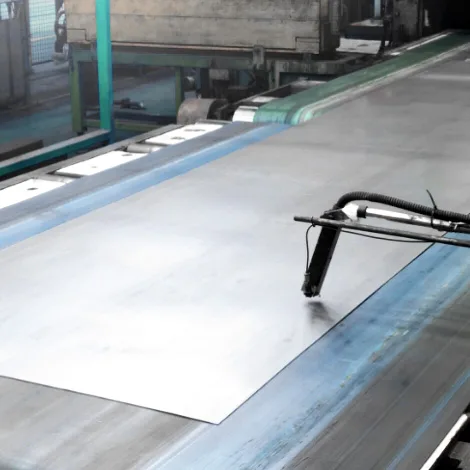
- Product Name: Hot-rolled, subsequently heat-treated steel plate. The "heat treatment" here refers to the "QT: Quenching + Tempering" listed in the standards. This means it didn't go straight to market after rolling; it underwent intensive "strength training" (quenching and tempering), where its grain structure was refined and its peroperty activated.
- Grade: BS960E.
- 960: Indicates a minimum yield strength of 960 MPa (Megapascals), classifying it as ultra-high-strength steel—the "heavy lifter" of the engineering machinery world.
- E: Signifies that it maintains excellent toughness even at -40°C, resisting the embrittlement that plagues many steels in extreme cold.
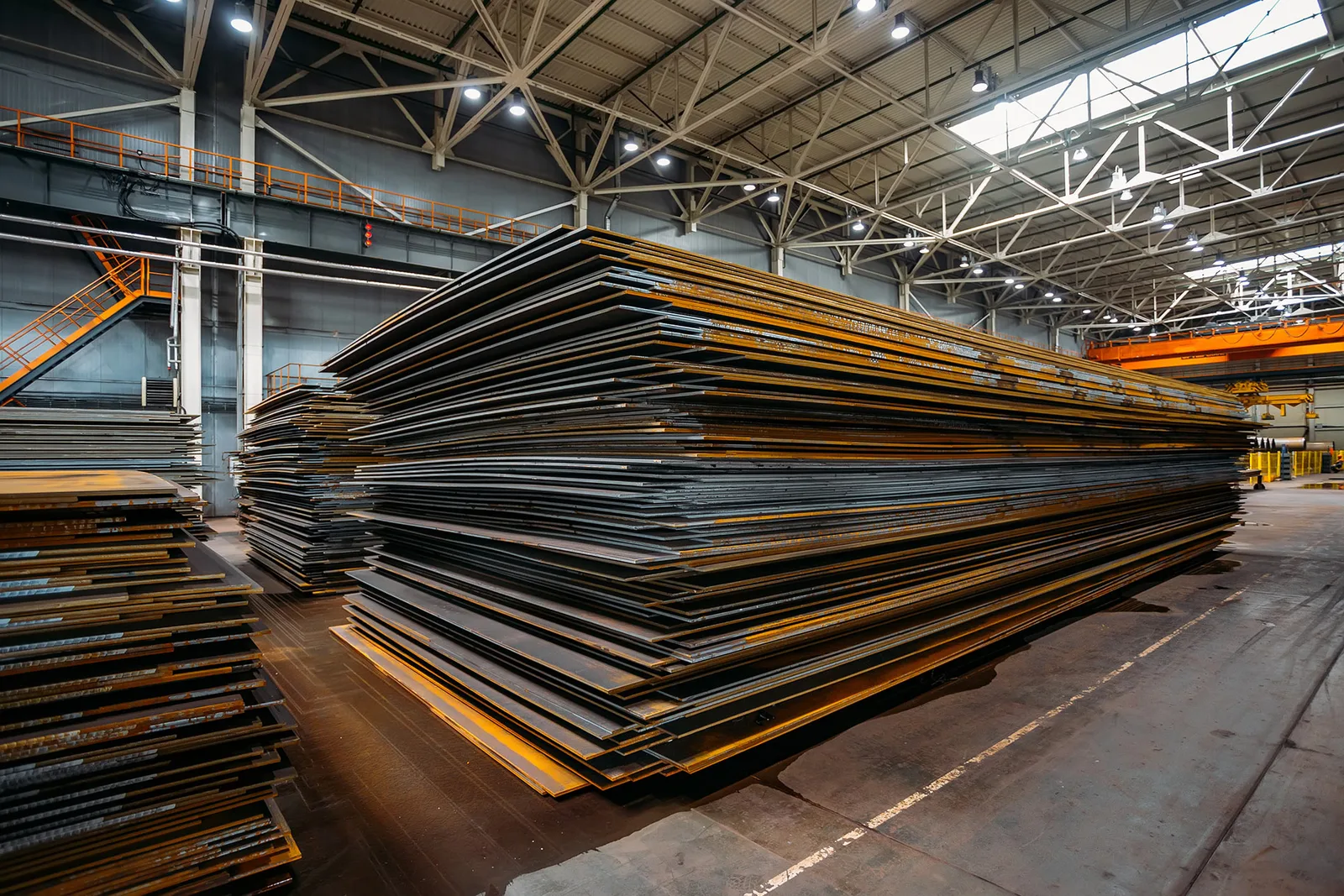
- Dimensions: 7.0mm thick × 1800mm wide × 12000mm long. A 7.0mm thickness paired with 960MPa ultra-high strength achieves an exceptional strength-to-weight ratio. This specification is often the gold standard for lightweighting in高端装备, such as the main beams of weight-sensitive special vehicles or high-stress connecting components, where thinner plates must bear greater loads.
Step 2: Read the "Physical Exam" – Interpreting Three Core Metrics
From the dense numbers in the table, let's focus on the three most critical benchmarks—the true tests of a steel's "mettle."
1. How Strong Is It? (Tensile Test)
- Location: "Tensile Test" section of the table.
- Key Metric: Yield Strength (ReH).
- Standard Requirement: ≥ 960 MPa.
- Actual Data: 1036 MPa (Transverse, T), 1051 MPa (Longitudinal, L).
Our Take:
Think of buying a battery rated for 10,000mAh that actually tests at 10,500mAh. This batch's actual strength significantly exceeds the standard (by nearly 80 MPa!). This surplus strength translates to the ability to withstand higher operational loads without permanent deformation. For designers, this means a greater safety margin and the potential for further structural optimization and weight reduction.
2. How Does It Handle the Cold? (Impact Test)
- Location: "Impact Test" section of the table.
- Key Metric: Impact Energy (KV2) at -40°C. This is a tough hurdle for high-strength steels. Many are hard at room temperature but can become glass-like and shatter in the cold (low-temperature brittleness).
- Test Condition: -40°C (simulating extreme environments like Siberia, Northeast China, or Scandinavia).
- Standard Requirement: ≥ 47 J.
- Actual Data: 49 J, 47 J, 55 J.
- Average (AVE.): 50 J.
Our Take:
With individual results of 49 J, 47 J, 55 J and an average of 50 J, the steel comfortably meets the ≥47 J standard. This demonstrates remarkable process stability, indicating precise control over composition (e.g., very low S,P content, CEQ of only 0.54%) and heat treatment for this production batch. Even in a -40°C mining operation, this plate retains sufficient toughness to resist sudden fracture.
3. Is It Workable? (Bend Test)
- Location: "Bend Test" at the bottom of the table.
- Test Result: OK (d=5.0 a). Note: This means a 90-degree bend around a mandrel with a diameter 5 times the thickness (5×7mm=35mm) was performed without cracking.
Our Take:
The biggest concern with steel this strong (1000MPa+) is that it might be "hard yet brittle," cracking upon bending. The "OK" result confirms this steel plate combines strength with ductility. During fabrication—cutting, drilling, bending—it is less prone to cracking, leading to lower scrap rates and smoother processing.
Step 3: The Story Behind the Data – What It All Means
This MTC corresponds to Heat Number 15104893, comprising 3 plates with a total weight of 3561 kg. The data—both strength (1036/1051 MPa) and toughness (47-55 J)—are solid and consistent. What does this tell us?
- Strong Lot-to-Lot Consistency: The performance variation across the 3 plates from the same heat of steel is minimal, indicating exceptionally stable smelting and rolling control for this batch.
- Full Traceability: The ordering unit ("Shanghai Baosteel Steel Trade Co., Ltd.") and consignee (Shanghai Baohui Steel) show this premium material was shipped directly from Baosteel's原厂 into a formal, large-scale storage and distribution channel. The source is clear, reliable, and fully traceable, eliminating risks of "re-branding" or mixing with non-original material.
Steel is not just cold metal; it is the industrial bedrock supported by countless precise data points. To those outside the industry, an MTC might be an inscrutable document. For us, it is the foundation of our promise to customers. We don't deal in pointless talk; we let the MTC do the talking.
The science of steel is vast and profound. We welcome insights and corrections from industry experts to help us all learn and grow together.