Welding Baosteel NM400 / NM500 Wear Plate: Preheat, Filler Metal and Real Joint Test Data

Jay Zheng
Nov 19, 2026
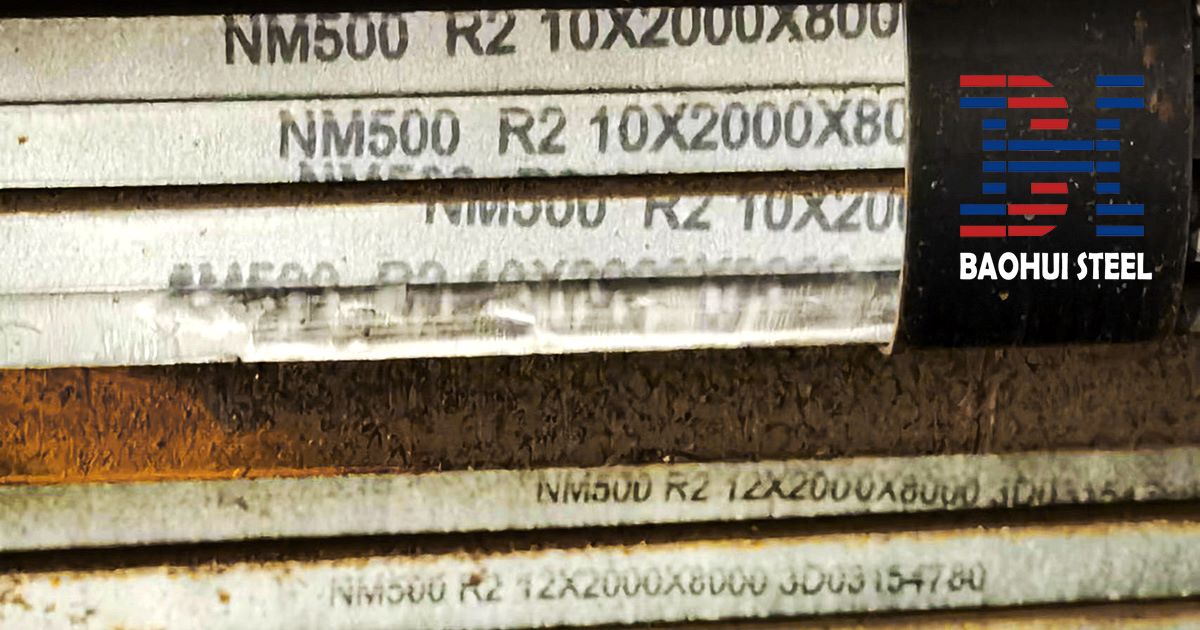
Welders who are new to abrasion-resistant plate usually learn one lesson the expensive way: NM400 and NM500 behave nothing like Q345 mild steel. The same hardening that gives the plate its wear life makes it crack-sensitive under the arc. This guide condenses Baosteel's official heat-treated products handbook (BRR series) into workshop-ready rules — preheat temperatures, interpass limits, heat input, filler metal selection — plus real weld joint test results published by Baosteel, so you are working from measured data rather than folklore. (Note: Baosteel's wear plate is now designated NM under GB/T 24186; the older BW name — BW400, BW450, BW500 — is the same product family.)
Preheat and interpass: the rule that prevents cracks
Hydrogen-induced cold cracking is the main risk when welding hardened steel. Baosteel's handbook gives simple, thickness-based rules:
| Plate thickness | Preheat | Maximum interpass temperature |
|---|---|---|
| < 10 mm | Not required (room temperature welding is acceptable) | ≤ 200 °C |
| ≥ 10 mm | 100 °C minimum | ≤ 200 °C |
| If ambient humidity is high or temperature is below 5 °C, raise the minimum preheat by a further 25 °C. Weld indoors, above 5 °C, wherever possible. | ||
For dissimilar-thickness joints, set preheat and interpass by the thicker plate; for joints between different strength grades, follow the higher-strength steel.
Process and heat input
- MAG/GMAW: Ar-rich shielding gas with 15–25 % CO2, flow 10–25 l/min. Keep the arc stable with minimal weave, use multi-pass technique, and hold heat input ≤ 12 kJ/cm. Automate long straight seams where possible.
- SAW: bake flux to the manufacturer's schedule; after drying, exposure to atmosphere must not exceed 4 hours; damp or caked flux is prohibited.
- Joint design: butt, fillet and lap joints are all acceptable. For lap joints the overlap must be at least 5× the thinner plate's thickness, and never less than 25 mm. Keep butt weld reinforcement ≤ 3 mm and avoid dense, crossing weld layouts.
- Preparation: check plate flatness (edge camber ≤ 0.5 mm, unevenness ≤ 0.5 mm), clean rust and oil within 30 mm of the groove, verify fit-up, and avoid striking arcs outside the weld zone.
Filler metal: why under-matching is the professional choice
Baosteel recommends slightly under-matching filler metal for wear plate: a consumible one strength class below the base metal. The weld then stays ductile and resists cracking, while the base plate — which wears at a fraction of the weld's rate — still governs service life. Preferred consumables are low-hydrogen, 80 kg-class wires and electrodes (basic-coated electrodes for manual metal arc).
Baosteel backs this with published joint tests. 10 mm BW450 (now NM450) was welded with Φ1.2 mm BH800-II solid wire, 60° V groove, no preheat, Ar+20 % CO2 shielding, heat input reduced to about 10 kJ/cm:
| Specimen size (mm) | Tensile strength Rm (MPa) | Fracture location | 180° cold bend (12a) | -40 °C impact KV2 (J) |
|---|---|---|---|---|
| 9.83 × 12.94 | 929 | Weld metal | Intact | 57 |
| 9.81 × 12.80 | 943 | Weld metal | Intact | 71 |
Fracture in the weld metal under tension is exactly what under-matching predicts — the soft, tough weld yields first and warns before anything fails in service.
Cutting, bending and straightening
- Cutting: thermal only — laser, plasma or water jet. Shearing and punching are not recommended on hardened wear plate (crack initiation risk at cut edges).
- Bending: follow the minimum bend radius in the delivery conditions; springback is large in high-strength steel, so overbend to hit the target angle. Surface quality, edge quality and bend direction all affect the result.
- Straightening: cold straightening preferred; if hot straightening is unavoidable, keep temperature ≤ 500 °C for 800–960 MPa class and avoid hot straightening entirely for 1100–1300 MPa class.
Field proof: why the welding discipline pays off
In a documented mining application, a wide-body dump truck floor was redesigned from 20 mm Q345 to 10 mm NM450, with Baosteel supporting simulation, fabrication tracking and in-service wear measurements. After about three months in the mine, the wear-steel floor had worn 0.3 mm versus 3 mm on the Q345 reference — roughly 10× the service life at half the thickness, with all welds intact. In dredging service, Baosteel's BMS abrasion-corrosion pipe steel measured 2.1× the wear-corrosion life of Q345B after 2 million m³ of slurry.
Sourcing genuine Baosteel wear plate
Welding parameters only matter if the plate is genuine. We supply NM400 / NM450 / NM500 from Baosteel with original mill test certificates, one per heat — see our comparison of NM400 vs Hardox 400 for what real certificate data looks like, or learn how to read a Baosteel mill certificate line by line. For grades, sizes and a current FOB quote, contact our sales engineers.