Baosteel NM450 vs Hardox 450: Specs, Price and Real Mill Certificate Data

Jay Zheng
Nov 5, 2026
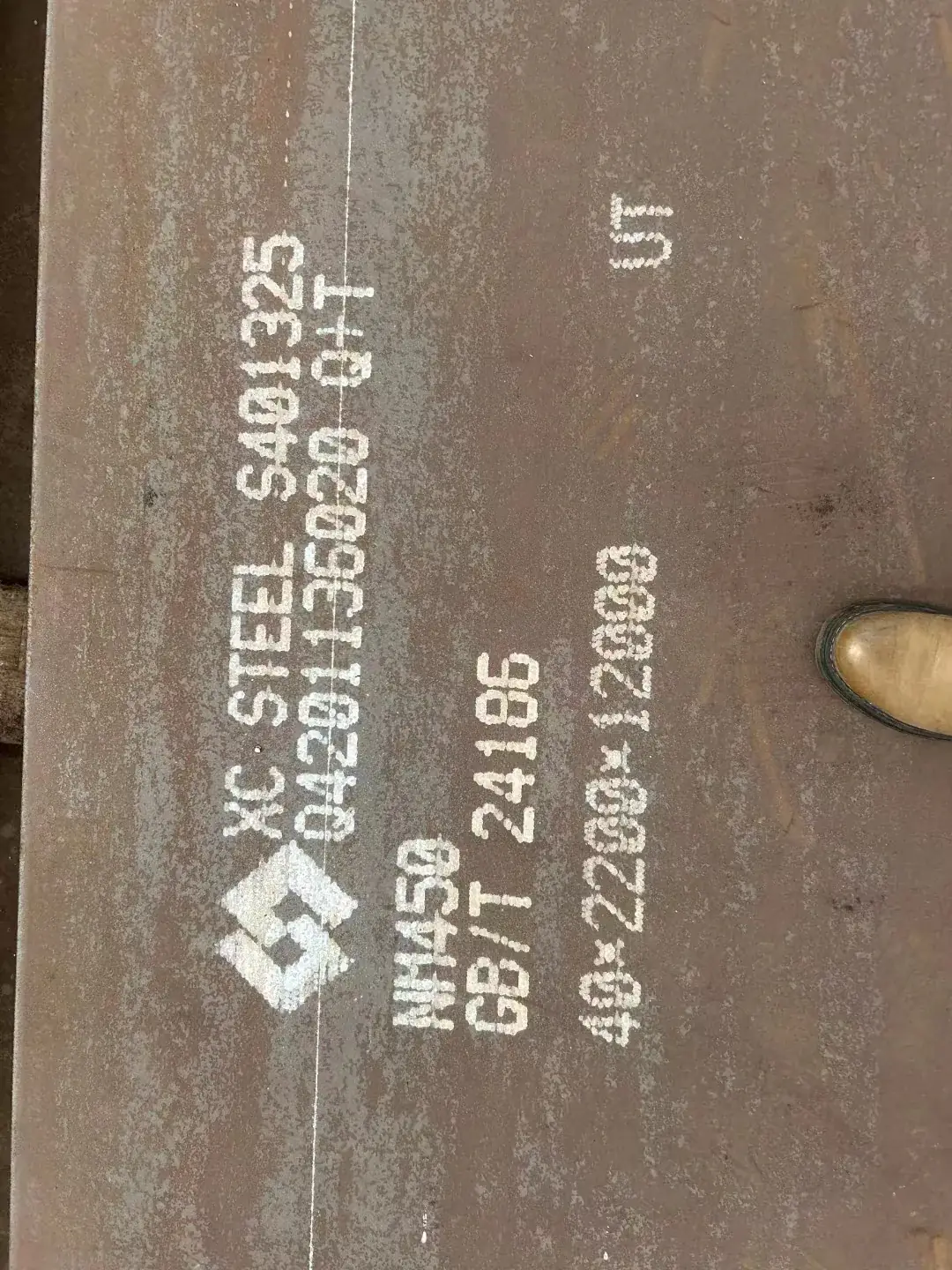
NM450 is the workhorse of the 450 HBW wear class — and the direct Chinese answer to SSAB's best-selling Hardox 450. Both are through-hardened, quenched-and-tempered plates built around the same promise: roughly 50 Brinell points over the 400 class, and measurably longer wear life. On paper the two are hard to tell apart. So this page does something datasheets do not: it puts real results from a genuine Baosteel inspection certificate — No. BGSAI2402270700100, a 10 mm plate delivered to Baohui Steel on 27 February 2024 — next to the published guarantees, so you can judge the steel rather than the marketing.
NM450 vs Hardox 450: guaranteed specifications
| Item | Baosteel NM450 | SSAB Hardox 450 |
|---|---|---|
| Standard / basis | GB/T 24186 + Baosteel technical delivery conditions | SSAB product datasheet |
| Hardness guarantee | 420–480 HBW | 425–475 HBW (plate ≤ 80 mm); 410–475 HBW (80.1–103 mm); 390–475 HBW (103.1–160 mm) |
| Yield strength | Real certificate: 1,250 MPa (ReH) | Typical 1,250 MPa — not guaranteed |
| Tensile strength | Real certificate: 1,464 MPa | Not stated as a guarantee on the datasheet |
| Impact toughness | Contract option; real certificate: KV2 avg 52 J at −20 °C | Typical values published, not guaranteed on standard grade |
| Thickness range | ≈ 1.5–25 mm heat-treated plate (incl. the 1.5 mm class unique to Baosteel); heavier gauges on request | Plate 3.2–160 mm; sheet 2.0–8.0 mm; CR sheet 0.8–2.1 mm |
| Delivery condition | Quenched + tempered | Quenched + tempered (through-hardened) |
What a real Baosteel NM450 certificate shows
The values below are not brochure figures — they are transcribed from inspection certificate No. BGSAI2402270700100, issued by Baoshan's core base (总部 / CORE BASE) on 27 February 2024 for a 10.00 × 1800 × 12000 mm plate consigned to Baohui Steel:
| Property | Certificate result | Reading |
|---|---|---|
| Brinell hardness | 449 / 451 / 457 HBW, average 452 | Dead centre of the 420–480 class |
| Yield strength ReH | 1,250 MPa | Matches the Hardox 450 typical value — as a measured result |
| Tensile strength Rm | 1,464 MPa | High strength reserve for structural wear parts |
| Elongation A | 17 % | Excellent ductility for a 450 HBW plate |
| Charpy V KV2, −20 °C | 57 / 50 / 49 J, average 52 J | Toughness most buyers do not expect at this hardness |
| Bend test | 90°, d = 6a (60 mm mandrel on 10 mm), OK | Forms cold without cracking |
| Ladle analysis | C 0.21 %, S 0.002 %, micro-alloyed Nb-Ti-B | Low-carbon clean steel — weld-friendly for its hardness |
Three things are worth noticing. First, the measured 452 HBW sits in the middle of the class — this is controlled quenching, not a lucky heat. Second, 52 J at −20 °C is real toughness: a plate that hard which still absorbs 50 joules in a winter impact test will not shatter in a grab bucket or a cold chute. Third, the chemistry — 0.21 % carbon with 0.002 % sulfur — is what makes the grade workshop-friendly: it bends 90° on a 60 mm mandrel and welds without drama. If you want to learn to read these fields yourself, see our line-by-line MTC guide.
Where Hardox 450 still has the edge — and where NM450 wins
Hardox 450 remains the default when a specification names it: global brand recognition, established stock in Europe and the Americas, and a datasheet every engineer has seen. If your tender says "Hardox 450 or approved equivalent", the approval paperwork is on you. NM450 wins on everything measurable in the invoice: a materially lower FOB price per ton (indicatively 760–830 USD/MT for standard sizes, versus the SSAB brand premium), thin heat-treated gauges from 1.5 mm — the 1.5 mm class is a Baosteel unique worldwide — and mill-level documentation, including EPDs verified per ISO 14025 for buyers whose tenders ask for embodied-carbon data. Same hardness class, same QT delivery, different economics.
Choosing between NM400, NM450 and NM500
If your NM400 lining is lasting under a year in abrasion-dominated service, step up to NM450 — the 50 HBW difference typically doubles life for a modest price increment. If the part sees severe sliding abrasion with acceptable impact (crusher liners under rock fall excepted), consider NM500 directly. And if impact and abrasion arrive together, choose the E-grade (NM450E / NM500E) rather than chasing headline hardness. See the full NM400/NM450/NM500 series page for stock sizes and FOB pricing, the NM400 vs Hardox 400 comparison if you are weighing the 400 class, or the AR500 vs Hardox 500 vs NM500 three-way read for the 500 HBW class.
Need NM450 with original Baosteel mill certificates? Send us your thickness and quantity — we reply with stock availability and a firm FOB quote.