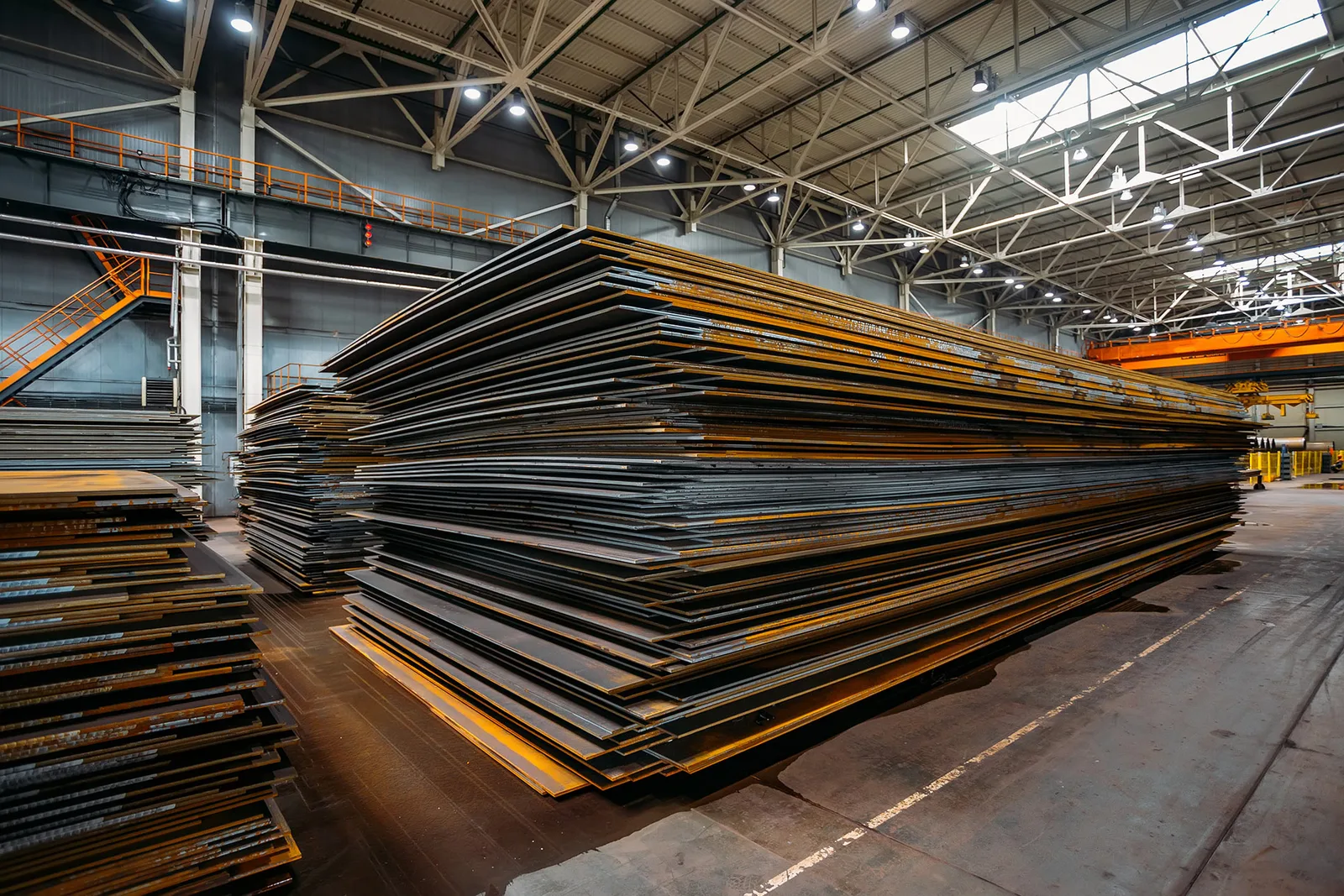
How to Read a Baosteel Mill Test Certificate (MTC), Line by Line

Jay Zheng
29 окт. 2026 г.
In steel trading, everyone asks "how much per ton". At Baohui we say it differently: the quotation decides whether you can buy — the MTC decides whether you dare to use it.
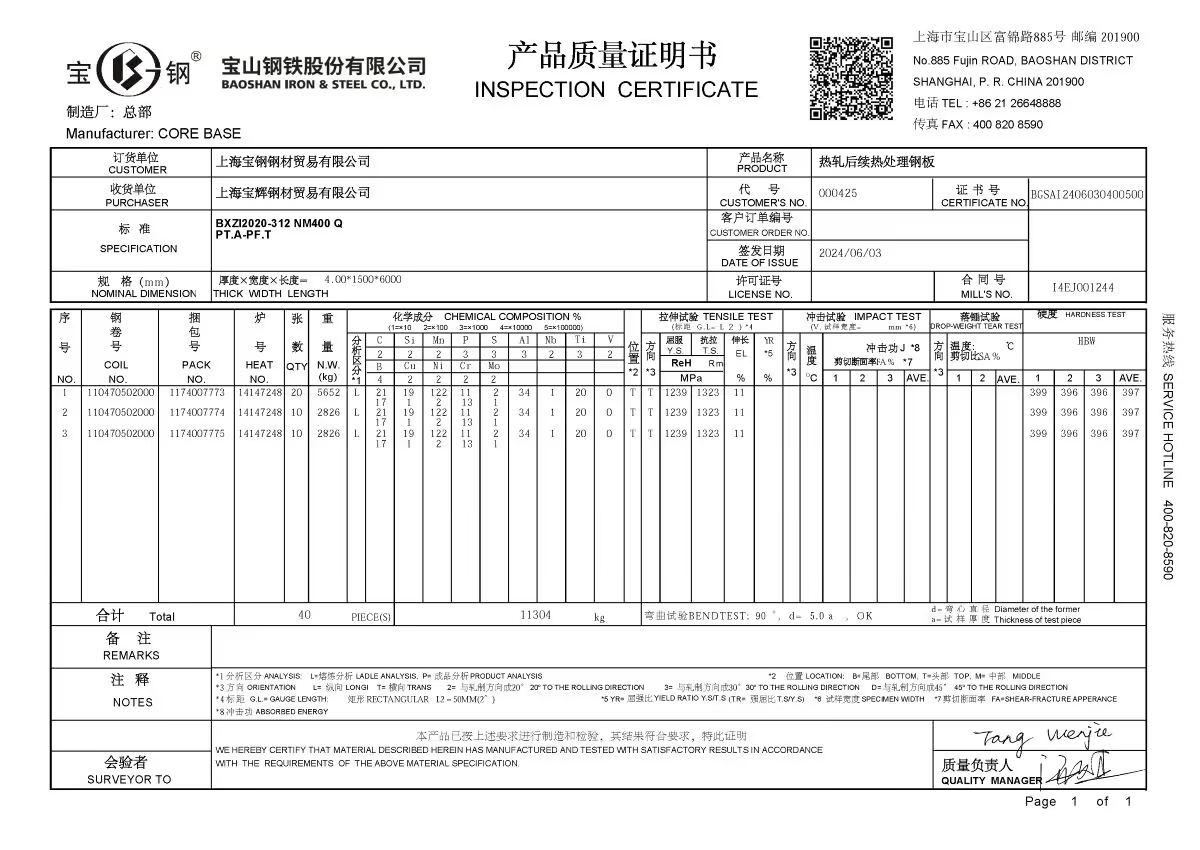
The MTC (mill test certificate, or 产品质量证明书 / INSPECTION CERTIFICATE) is the single most important document attached to any steel plate. Below, we walk through a genuine Baosteel certificate field by field — a BS960E plate — and show how the same reading applies to any Baosteel grade, from NM400 wear plate to shipbuilding steel.
Step 1: Read the identity block — who made it and what it is
The header section of the certificate is the plate's household registration.
- Manufacturer. On our example certificate, the manufacturer reads "总部 / CORE BASE" — Baoshan Iron & Steel Co., Ltd., Shanghai headquarters. That designation means the plate comes off Baosteel's core Baoshan production lines, the group's top-tier process and quality-control system. Certificates from the Wuhan base instead show "武汉钢铁有限公司 / Wuhan Iron & Steel Co., Ltd.". Both are Baowu Group mills.
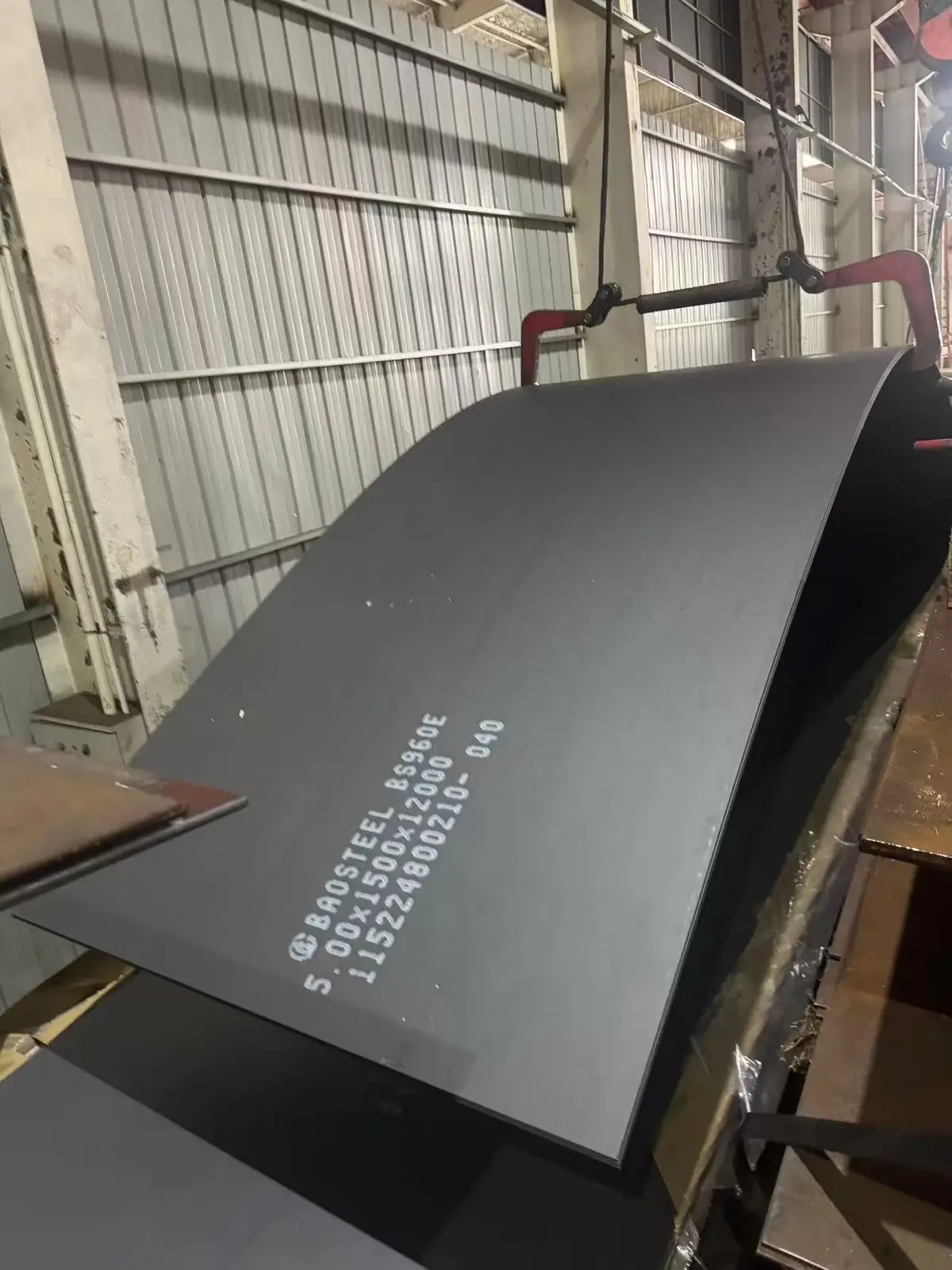
- Product name. "热轧后续热处理钢板" — hot-rolled plate, subsequently heat-treated. The delivery condition column spells it out: QT: quenched + tempered. The plate was not sold as-rolled; it went through hardening and tempering — the deep "fitness training" that refines the grain and unlocks its performance.
- Grade. On our example: BS960E. The number is a promise — minimum yield strength of 960 MPa, ultra-high-strength structural steel. The letter is just as important: E means the steel keeps its toughness at -40 °C and will not turn glass-brittle in extreme cold.
- Dimensions. Our example: 7.0 mm × 1800 mm × 12000 mm. A 7 mm plate at 960 MPa delivers an exceptional strength-to-weight ratio — the profile used on weight-critical special-vehicle frames and high-stress joints, where thinner plate carries larger loads.
Step 2: Read the three core tests
The dense table in the middle of the certificate is the plate's medical report. Three results matter most.
2.1 Strength — the tensile test (TENSILE TEST)
Key field: yield strength (ReH), the stress at which permanent deformation begins.
- Requirement for BS960E: ≥ 960 MPa.
- Measured on this certificate: 1,036 MPa (transverse, T) and 1,051 MPa (longitudinal, L).
Think of it like a battery rated at 10,000 mAh that actually tests at 10,500. The measured strength runs nearly 80 MPa above the floor — in service that means the equipment carries larger loads without permanent deformation, and designers keep an extra safety margin.
2.2 Cold resistance — the impact test (IMPACT TEST)
Key field: Charpy V-notch impact energy (KV2) at -40 °C — the hardest test for high-strength steel. Many steels that feel rock-hard at room temperature shatter like glass in winter. This test simulates Siberian, Nordic or high-altitude service.
- Requirement for BS960E: ≥ 47 J.
- Measured: 49 J, 47 J, 55 J — average 50 J.
Three consistent results across the heat show process stability: with sulfur and phosphorus held to very low levels (this heat's CEQ is only 0.54 %), composition control and heat treatment were precise. Even at -40 °C, the plate absorbs energy instead of cracking.
2.3 Workability — the bend test (BEND TEST)
Ultra-high-strength steel is useless if it cracks when your workshop bends it. The bend test reports OK, d = 5.0 a — bent 90° around a mandrel of five times the plate thickness (5 × 7 mm = 35 mm) with no cracks. Strength and formability together: that is what "刚/柔并济" looks like in numbers.
Step 3: Read the story behind the data
The footer tells you about consistency and provenance.
- Heat stability. Our example certificate covers heat 15104893 — 3 plates, 3,561 kg total. The tensile values (1,036 / 1,051 MPa) and impact values (49 / 47 / 55 J) vary very little between plates from the same melt: the mill controlled that heat's melting, refining and rolling tightly.
- Traceability. The purchaser field shows Shanghai Baosteel Steel Products Trading — the mill's official sales channel — with a named logistics consignee. The plate travelled a documented route from the mill into formal warehousing. Full traceability, no rebadging, no mixing.
The four-point check we run on every certificate
| Check | What to look for | Red flag |
|---|---|---|
| 1. Manufacturer | Baoshan HQ ("CORE BASE/总部") or Wuhan Iron & Steel | Unnamed or non-Baowu mills on a "Baosteel" certificate |
| 2. Certificate number | BGSAI… (Baoshan) / BGBWI… (Wuhan) format, plausible date | Random numbers, no date logic |
| 3. Measured values | Tensile, hardness and impact filled in per heat, internally consistent | Blank fields, or identical values across different heats |
| 4. Party chain | Mill → official trading arm → named consignee → your supplier | Broken or untraceable chain |
Steel is not just cold metal — it is an industrial building block supported by precise data. To outsiders an MTC is an unreadable sheet of paper; to us at Baohui it is the foundation of every promise we make. We do not trade in talk — we answer with mill certificates. Every plate we ship, from NM400 wear plate to BS960E high-strength steel, carries its original certificate, one per heat.
Want a certificate with your next order? Contact Baohui Steel — and read our NM400 vs Hardox 400 comparison to see what real certificate data looks like in a specification debate.