Green Steel Explained: Baosteel's Roadmap to Carbon Neutrality

Jay Zheng
2026年11月12日
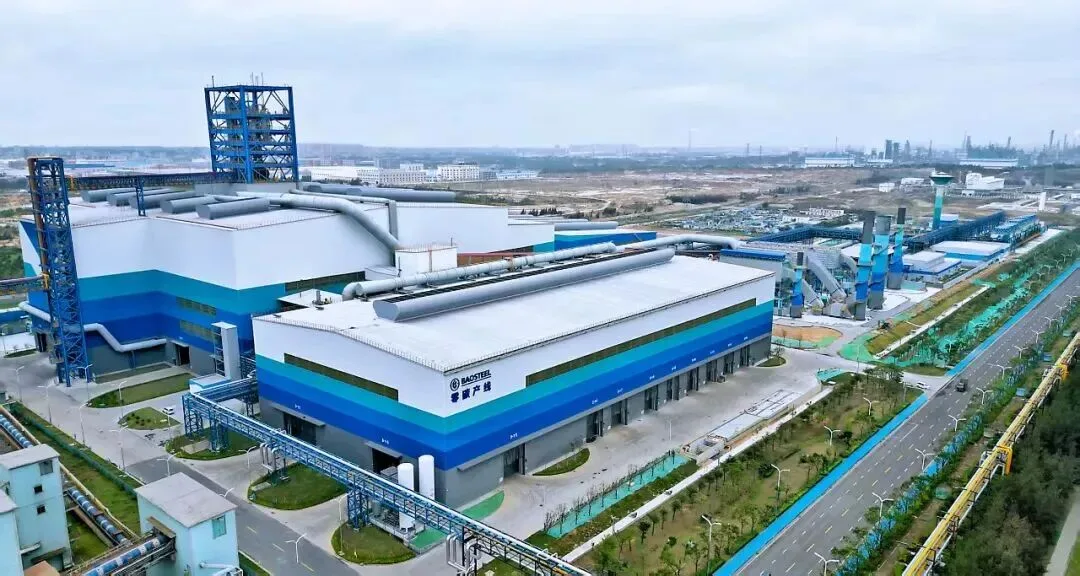
"Green steel" has become one of the most abused phrases in the industry — every mill claims it, few prove it. This guide cuts through the slogans with audited numbers: what green steel actually is, why your procurement department will soon care more about CO2 than about grade alone, and where Baosteel — the mill behind 90% of what we sell — actually stands on the road to carbon neutrality.
What green steel actually means
Conventional steel is made by reducing iron ore with carbon (coke) in a blast furnace — chemistry that inevitably releases CO2. About 2.0–2.3 tonnes of CO2 per tonne of steel is the global norm for the integrated route. Green steel means the same product with a radically smaller carbon bill, achieved through one or more of:
- Hydrogen-based direct reduction — using hydrogen (H2) instead of carbon to strip oxygen from iron ore, releasing water instead of CO2;
- Electric arc furnaces (EAF) — melting scrap or direct-reduced iron with electricity, ideally renewable;
- Energy and efficiency optimization — waste-heat recovery, renewable power purchase, low-carbon logistics.
Because "green" has no single legal definition, the only trustworthy proof is audited product-level data — which is exactly what an EPD (Environmental Product Declaration) provides. More on that below.
Baosteel's carbon roadmap: 2023, 2035, 2050
| Milestone | Commitment | How |
|---|---|---|
| 2023 | Carbon peak reached | Energy-efficiency drives across all four bases (Baoshan, Wuhan/Qingshan, Zhanjiang, Meishan) |
| 2035 | -30 % emissions | Process restructuring: hydrogen metallurgy, EAF share growth, energy-mix optimization |
| 2050 | Carbon neutrality | Full low-carbon process chain, green power, carbon capture where residual emissions remain |
Management systems behind the numbers: Baosteel operates certified ISO 14001 (environment), ISO 50001 (energy) and IECQ QC 080000 (hazardous substances) systems, participates in CDP climate disclosure, and has published EPDs — independently verified per ISO 14025 — on the CISA-EPD platform since 2025.
The Zhanjiang hydrogen route: proof, not promises
Baosteel Zhanjiang Steel commissioned China's first million-tonne hydrogen-based shaft furnace at the end of 2023, and has since connected it to newly built electric arc furnaces and continuous casting — a complete "hydrogen shaft furnace reduction → efficient EAF smelting → low-carbon rolling" short-process line.
- Feedstock: hydrogen-based DRI plus scrap steel, replacing most virgin hot metal;
- Emissions cut: an estimated 50–80 % lower than an equivalent blast furnace–converter route — potentially over 3.14 million tonnes of CO2 avoided per year at full operation;
- Energy: Zhanjiang already runs 124 MW of on-site solar (≈150 GWh/year planned) and has invested in a 400 MW offshore wind development, building a "wind–power–hydrogen" supply chain for the line.
This is not a pilot beaker: it is a million-tonne industrial line, and it positions Baosteel among the handful of mills worldwide with commercial-scale hydrogen steelmaking.
What this means for buyers
- CBAM. The EU Carbon Border Adjustment Mechanism already requires importers of steel to report embedded emissions, and starts charging for them. A supply chain anchored in Baosteel EPD data gives you auditable numbers instead of estimates.
- Scope 3 pressure. If you sell equipment into EU or North American supply chains, your customers must report the footprint of your steel. Mill-verified EPDs per product family make you the easier supplier to approve.
- Tender requirements. Public construction and infrastructure tenders in the EU increasingly score EPDs. Steel with verified declarations — rather than a trading company's letter — wins those points.
Baosteel's hot-rolled products already carry a verified EPD: roughly 2.28 t CO2e per tonne for conventional production, with the hydrogen-route share falling fast. We break the numbers down in our companion article, Steel EPD Explained: Baosteel's Hot-Rolled Data, Line by Line.
For the product side of the story, see Baosteel's BeyondEco-30 hot-rolled launch and our Baosteel supply page. To put low-carbon plate into your next order — with EPD data and original mill certificates — contact Baohui Steel.