Welding BS960E: Carbon Equivalent, Preheat Temperatures, Heat Input and Filler Metal (Baosteel Handbook Data)

Jay Zheng
Nov 19, 2026

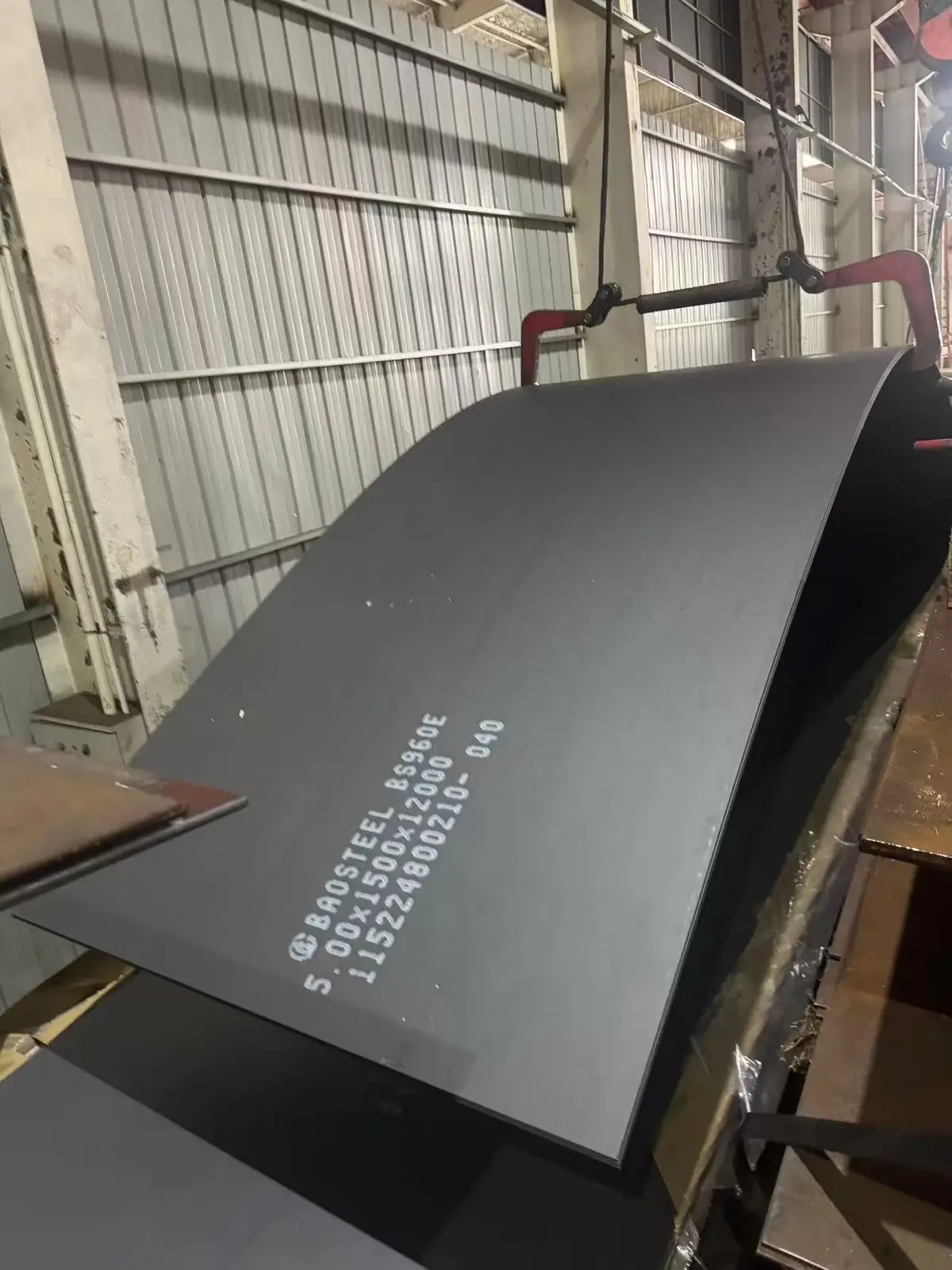
Ultra-high-strength steel only earns its keep when the welds survive. BS960E — Baosteel's quenched-and-tempered 960 MPa structural grade — welds very well, but it demands tighter discipline than mild steel: controlled preheat, capped heat input and correctly matched filler metal. This guide is built on Baosteel's official heat-treated products handbook (BRR series): carbon equivalent values, preheat rules, GMAW heat input limits, the EN/AWS/BH filler matching table, and Baosteel's own published BS960E joint test results.
Carbon equivalent: why BS960E is weldable at all
Crack sensitivity in HSLA steel is driven by carbon equivalent. Baosteel publishes both IIW carbon equivalent (Ceq) and the cold-crack index Pcm for the entire BS family:
| Grade | Ceq (IIW) | Pcm |
|---|---|---|
| BS800E | 0.47 | 0.25 |
| BS900D / BS900E | 0.52 | 0.28 |
| BS960D / BS960E | 0.52 | 0.28 |
| BS960HB / BS960LR | 0.52 | 0.28 |
| BS1100D / BS1100E | 0.56 | 0.30 |
| BS1300D | 0.64 | 0.37 |
At Ceq 0.52 / Pcm 0.28, BS960E sits in the same band as most commercial 960 MPa steels worldwide — weldable with ordinary GMAW equipment, provided the rules below are followed.
Preheat and interpass temperatures
The handbook's preheat table for the BS family is thickness- and grade-based:
- BS800–BS960, up to ~14 mm: room temperature (20 °C) is the listed minimum preheat under normal conditions.
- BS1100–BS1300: minimum preheat rises with strength — up to 150 °C for the highest grades.
- Always: if ambient humidity is high or temperature is below 5 °C, add 25 °C to the minimum preheat. For joints of unequal thickness or mixed grades, preheat by the thicker plate and the higher-strength steel.
GMAW heat input limits
Heat input is where 960 MPa welding most differs from everyday fabrication. Excessive heat input softens the HAZ and undermines the temper that gives the steel its strength. Baosteel caps GMAW heat input by gauge (BS960 class values shown):
| Plate thickness t | t ≤ 6 mm | 6 mm < t ≤ 10 mm | 10 mm < t ≤ 14 mm |
|---|---|---|---|
| Max. heat input Q | ≤ 8 kJ/cm | ≤ 10 kJ/cm | ≤ 12 kJ/cm |
Baosteel's reference procedure for BS960E uses 80 % Ar + 20 % CO2 shielding at 20 l/min, a manual root pass on the back side followed by back-gouging, then automated fill and cap passes.
Filler metal matching: EN, AWS and Baosteel's BH series
Choose filler by the strength the weld must deliver. Baosteel's official matching table maps weld yield levels to all three common classification systems:
| Weld yield level Rp0.2 (MPa) | 500 | 600 | 700 | 800 | 900 |
|---|---|---|---|---|---|
| EN standard | EN440 G50X | EN12534 G62X | EN12534 G69X | EN12534 G79X | EN12534 G89X |
| AWS standard | ER80S-X / ER90S-X | ER90S-X | ER100S-X | ER110S-X | ER120S-X / ER140S-X |
| Baosteel wire | BH600-II | BH700-II | BH800-II | BH900-II | BH1000-II |
| Typical base steel | — | BS800 | BS900 / BS960 | BS1100 / BS1300 | |
- Equal-strength matching for load-bearing welds whose joints must guarantee strength in high-stress service.
- Lower-strength matching for tie welds and other low-stress locations — a ductile weld that yields first is often the safer design.
Real joint test data: BS960E + BH900-II / BH1000-II
Baosteel publishes the proof, not just the recommendation. BS960E test panels were welded with BH900-II and BH1000-II wires under the procedure above:
| Wire | Panel size a×b (mm) | Joint tensile Rm (MPa) | Fracture location | 180° cold bend (6a) | -40 °C impact KV2 (J) |
|---|---|---|---|---|---|
| BH900-II | 8.57 × 12.70 | 990 | Weld metal + HAZ | Intact | 50 |
| BH1000-II | 8.36 × 12.80 | 962 | HAZ | Intact | 59 |
| BH1000-II | 8.31 × 12.70 | 1,032 | Weld metal | Intact | 47 |
| BH900-II | 8.40 × 12.62 | 989 | Weld metal | Intact | 53 |
Joint strengths of 962–1,032 MPa mean the weld develops the full 960 MPa class; intact 180° bends and 47–59 J at -40 °C confirm the heat-affected zone kept its toughness.
Cutting, bending, straightening
- Cutting: thermal only — laser or plasma — smooth cut surface, negligible HAZ. Shearing and blanking are not recommended for 800 MPa and above.
- Bending: BS grades have good plasticity for cold bending; keep the radius above the delivery-condition minimum. Springback is large — overbend to reach the target angle, and mind surface quality, edge quality and bend direction.
- Straightening: cold preferred. If hot straightening is unavoidable: ≤ 500 °C for 800–960 MPa grades; not recommended at all for 1100–1300 MPa grades.
Where to get BS960E with real certification
We supply BS960E and the wider high-strength range from Baosteel with original mill test certificates — the same certificate format we decode in our guide to reading a Baosteel mill certificate line by line. For an honest, data-driven view of how it competes with European 960 MPa steels, see BS960E vs Strenx 960 and the Baosteel supply program. For gauges, quantities and FOB pricing, contact our sales engineers.