
Green Steel & Low-Carbon Baosteel Plate for Global Projects
Source Baosteel hot-rolled products with lower-carbon production routes, traceable environmental documentation and export support built for EU procurement. BeyondECO routes, EPD and carbon-footprint documents and CBAM-ready data — aligned with your grade, route and reporting boundary before ordering, not after shipment.
Why low-carbon steel documentation matters in 2026
Three forces have converged to make carbon data part of a steel purchase, not a marketing extra:
- CBAM is in its definitive period. Since 1 January 2026, steel imported into the EU carries a carbon cost: importers must surrender CBAM certificates matching the embedded emissions of their goods under Regulation (EU) 2023/956.
- Buyers must report. Large EU companies under the CSRD and EU Taxonomy increasingly transfer data requests down the supply chain — product-level footprints, EPDs and verification references arrive in RFQs as standard fields.
- Claims are audited. Vague "green steel" statements invite greenwashing scrutiny. Procurement teams now ask for the certificate number, the standard, the system boundary and the validity period.
This page organizes what Baosteel actually produces (BeyondECO routes), the certificates that exist, and the document types EU teams typically need — so you can evaluate supply rather than slogans.
How Baosteel BeyondECO reduces carbon emissions
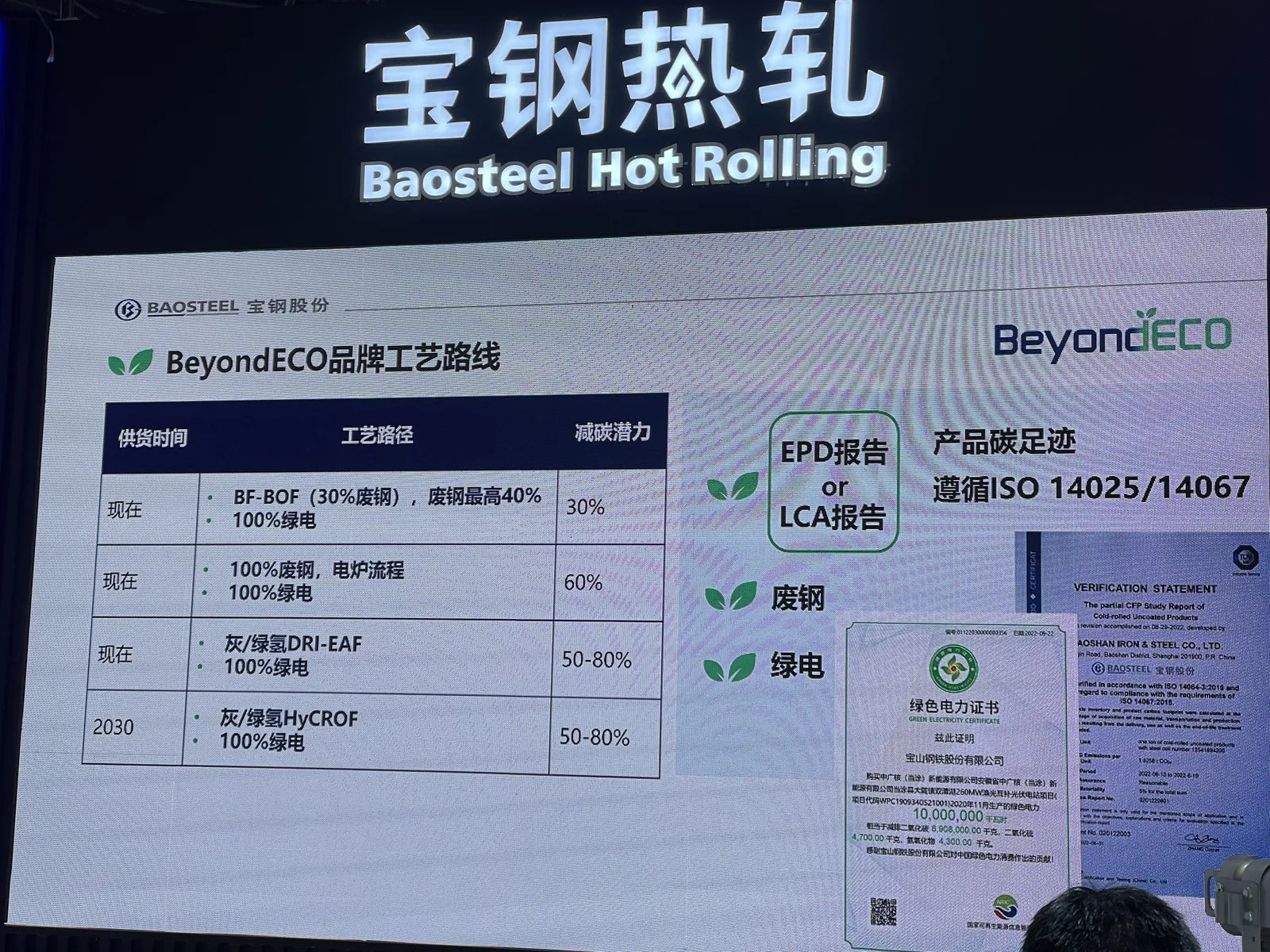
Green steel is not one single furnace technology. Baosteel's BeyondECO portfolio uses several production routes. The reduction figures below come from Baosteel's official Bauma China 2026 exhibit materials; the applicable route and product-specific result must be confirmed for each order.
| Production route | Key inputs / technology | Presented carbon reduction |
|---|---|---|
| BF–BOF + scrap | Blast furnace–basic oxygen furnace, 30% scrap (up to 40%) and 100% green electricity | 30% |
| Scrap-based EAF | 100% scrap electric arc furnace and 100% green electricity | 60% |
| Hydrogen-based DRI–EAF | Grey or green hydrogen direct-reduced iron feeding an electric arc furnace | 50–80% |
| HyCROF, targeted for 2030 | Hydrogen-rich carbon recycling oxygen furnace route | 50–80% |
Important: these are route-level figures, not a blanket promise for every plate. Availability, baseline, calculation boundary and certified footprint vary by product and mill. We confirm the exact document scope with your RFQ.
Documents your EU procurement team will ask for
Low-carbon procurement runs on paperwork. These are the document types that appear in EU RFQs and tenders, and how each one is handled in a Baosteel-based supply chain:
| Document | Standard / basis | What it proves | When you receive it |
|---|---|---|---|
| Environmental Product Declaration (EPD) | EN 15804+A2, ISO 14025 (Type III) | Verified environmental indicators per life-cycle stage for a defined product | Available for selected products; confirmed with the mill per order |
| Product carbon footprint | ISO 14067 / LCA | kg CO₂e per tonne with a declared system boundary | Per route and product, confirmed before you order |
| Low-carbon product certificate | T/CISA 452-2024 | Third-party evaluation of the product's low-carbon level | Example displayed below; scope depends on mill and product |
| Green electricity certificate | Route electricity attribute | The share of renewable electricity used in the selected production route | Declared together with route-level data |
| Mill Test Certificate (MTC) | EN 10204 3.1 | Mechanical and chemical properties of your actual heat/batch | With every shipment |
Tell us at inquiry stage which format your tender requires — EPD type, verification body, language and reporting boundary — and we will confirm which documents are available for the proposed grade and route before you commit.
CBAM and steel imports into the EU: what changes from 2026
The EU Carbon Border Adjustment Mechanism (Regulation (EU) 2023/956) entered its definitive period on 1 January 2026. For steel imports this means:
- Embedded emissions now have a price at the border. Authorized CBAM declarants must buy and surrender CBAM certificates corresponding to the emissions embedded in the steel they import. Fewer embedded emissions per tonne means fewer certificates to surrender.
- Production data becomes a customs-critical document. The declarant needs verified per-tonne embedded-emissions data for the production installation — this is where supplier documentation decides how smooth your declaration is.
- Claims must be defensible. The emissions figure you declare rests on mill-level data and certificates. Route-level reduction claims (for example a BeyondECO route) should be backed by documents a verifier can check.
How we support: for low-carbon orders we align with the mill on the route, obtain the available certificate and carbon data for the agreed product, and hand your team a document package matched to your CBAM reporting boundary. We supply steel and mill documentation; the CBAM declaration itself stays with your authorized declarant or customs representative. Official mechanism and timelines: European Commission — CBAM.
Which products can be supplied with a lower-carbon route?
Baosteel's hot-rolled portfolio can be evaluated for BeyondECO and low-carbon supply. Baohui focuses on export-ready plate for demanding applications, including:
- Wear-resistant steel: NM400, NM450, NM500, NM550, NM600 and Baosteel BW series for mining, buckets, dump bodies and cement equipment.
- High-strength and ultra-high-strength steel: BS600MC, BS700MC, BS960E, BS1100E and related grades for cranes, aerial platforms, trailers and lightweight structures.
- Hot-rolled automotive structural steel: chassis beam, wheel, axle-housing and truck-upgrading grades—distinct from cold-rolled automotive sheet.
- General structural steel: selected hot-rolled grades for machinery and fabricated structures.
Send the grade, standard, dimensions, quantity, destination and required carbon-reduction level. We will check route availability, minimum order requirements and the document package with the mill.
Physical evidence, not just a low-carbon claim
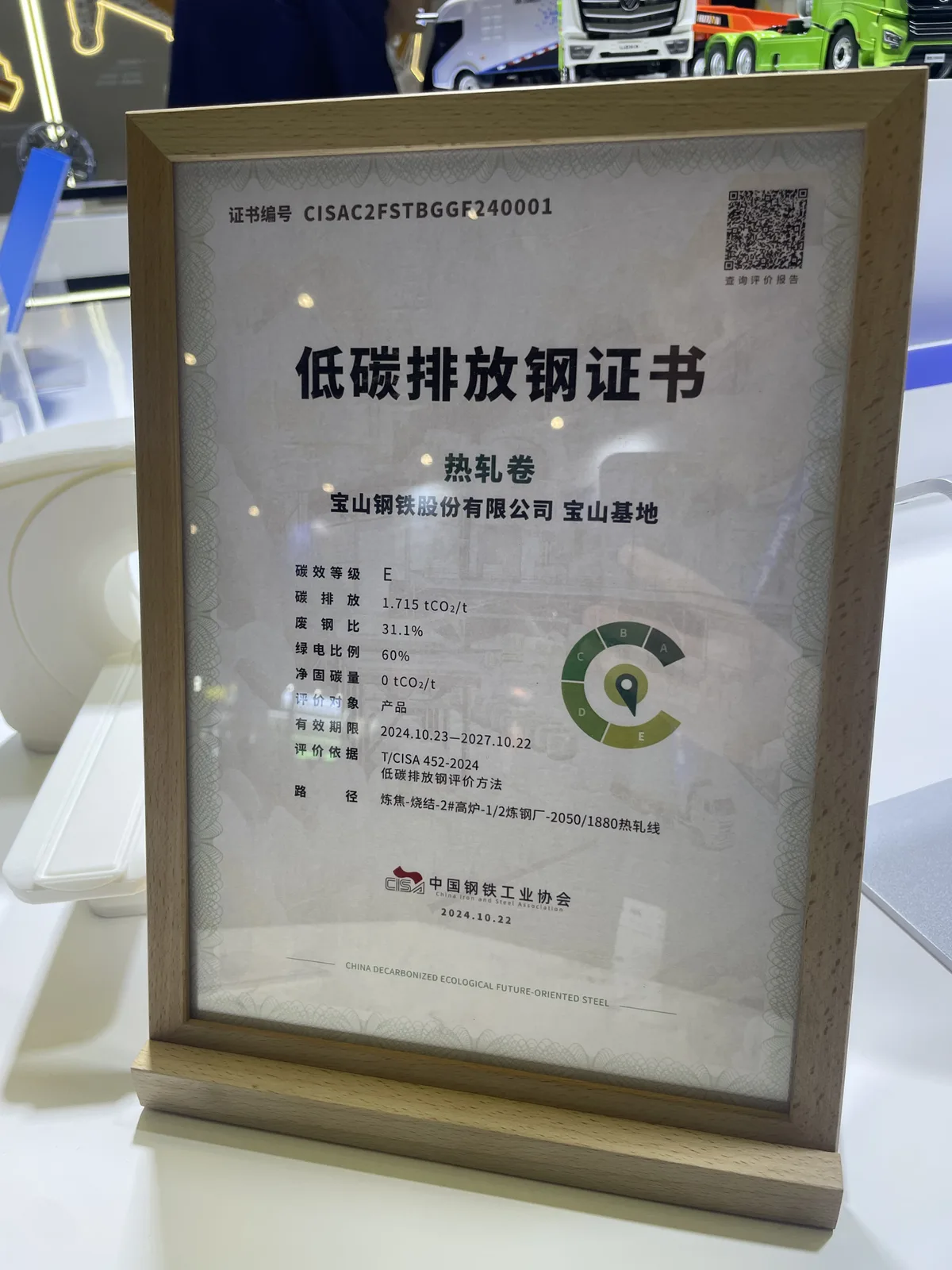
Baosteel's low-carbon hot-rolled exhibit included a certificate issued under T/CISA 452-2024. The displayed Baoshan-base hot-rolled coil certificate states 1.715 tCO₂/t, a 31.1% scrap ratio and 60% green electricity, with validity from October 2024 to October 2027.
This is an example of one certified product and period—not a universal footprint for all Baosteel steel. Baohui helps buyers match the ordered grade and heat to the available mill documentation.
BeyondECO products and environmental documentation
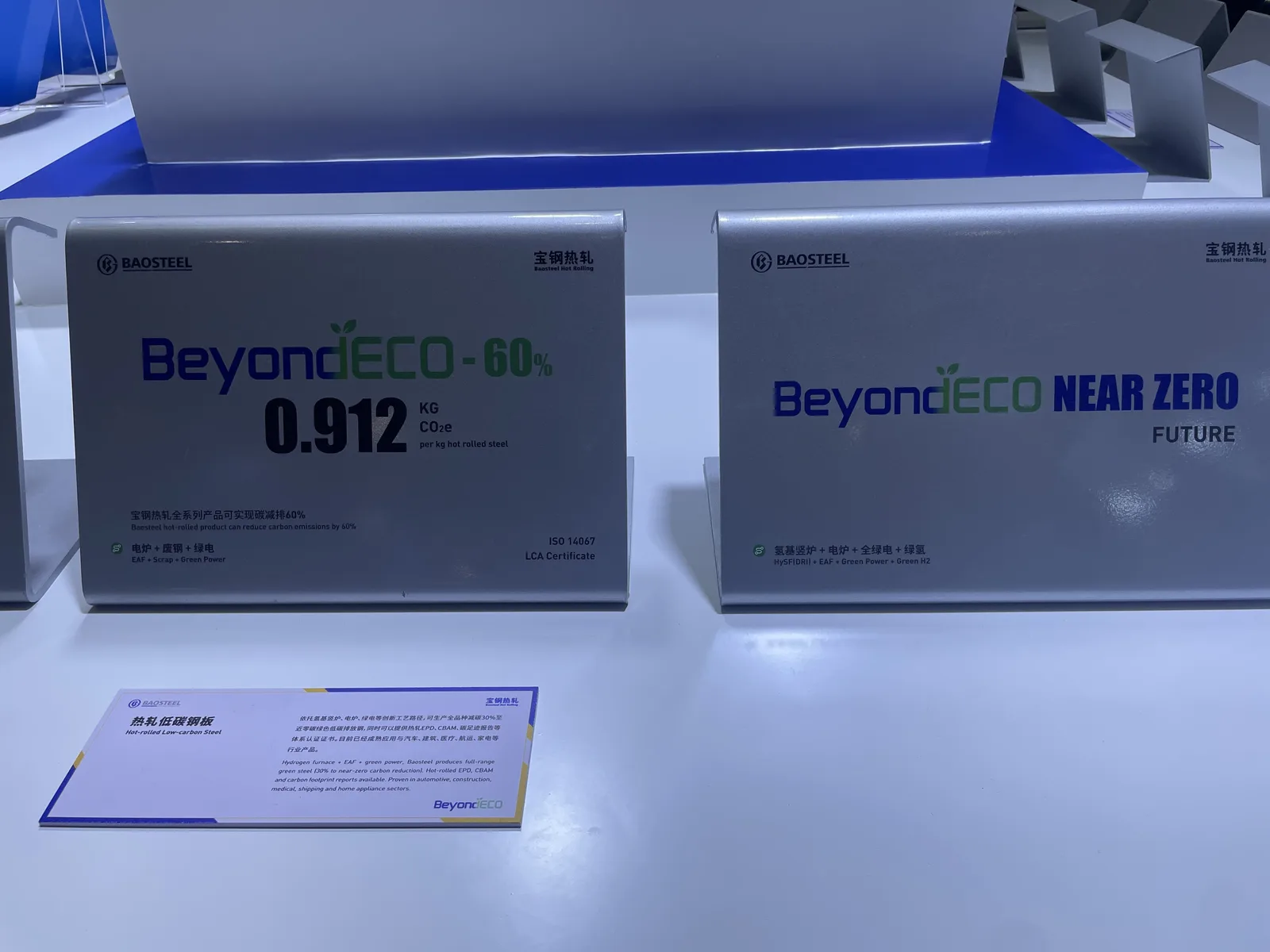
The BeyondECO display included a -60% sample plate marked 0.912 kg CO₂e, near-zero material and low-carbon hot-rolled product labels. Baosteel's materials also identify EPD and LCA work based on ISO 14025 and ISO 14067, together with green-electricity certificates.
For EU projects, tell us your CBAM reporting boundary, embedded-emissions data requirement and any customer-specific EPD format at inquiry stage. We will clarify which documents are available for the proposed product and route before you place the order.
Baohui's role in your green-steel supply chain
Shanghai Baohui Steel is an annual-agreement Baosteel distributor and a stockist for Baosteel heat-treated products. Our low-carbon supply experience covers grade selection, mill-route coordination, stock and new-production comparison, export packing and document preparation.
- Define the target: mechanical grade and carbon requirement are specified separately, so “green” never replaces the engineering specification.
- Confirm the evidence: certificate type, calculation boundary, EPD/LCA availability and reporting period are checked against your project.
- Coordinate supply: we compare available stock and mill production, then arrange inspection, processing and export delivery.
This approach is designed for European procurement teams that need usable documentation and a clear audit trail, not a generic environmental slogan.
How we keep this page honest
- Traceable sources. Route figures and certificate examples come from Baosteel official exhibit material (Bauma China 2026, Shanghai) and displayed documents — not from press summaries.
- Route ≠ plate. 30% / 60% / 50–80% are route-level results. The applicable figure, baseline and calculation boundary are defined by the issuer for a specific product and period.
- One certificate, one scope. The T/CISA 452-2024 certificate shown covers a defined Baoshan-base hot-rolled product and validity window (October 2024 – October 2027) — it is not a universal footprint for all Baosteel steel.
- No invented numbers. Where a per-order value matters (footprint, reduction %, premium), we confirm it with the mill instead of guessing.
- We don't rank competitors. European mills publish their own low-carbon programmes; without comparable public data we make no claims about them.
Verification date for this page: 25 November 2026. Spotted an error? Tell us — corrections are applied here and in the change log of our trade-policy pages.
Green-steel technical library
Continue with our existing technical explainers and Baosteel updates:
- Green steel explained: Baosteel's carbon-neutral roadmap
- Steel EPD explained: how to read Baosteel hot-rolled EPD data
- A breakthrough in green steelmaking
- BeyondECO 30 hot-rolled sheet: green-steel innovation
- Baosteel launches BeyondECO 30 hot-rolled products
- Why green steel can become a green passport
- Baohui and Baosteel: low-carbon industrial upgrading
- Steel import tariffs & trade policy by country — border costs now include carbon; tariff and CBAM planning belong together.
Green steel procurement FAQ
Is green steel a separate mechanical grade?
No. Green or low-carbon describes the production route and verified environmental footprint. The mechanical grade—such as NM400 or BS700MC—still needs to be specified and certified separately.
Does every Baosteel plate automatically provide a 60% reduction?
No. The 30%, 60% and 50–80% figures belong to different routes and conditions. Product availability and the actual certified result must be confirmed for the specific order.
Can Baohui provide EPD or carbon-footprint documents?
We coordinate the available mill EPD, LCA, carbon-footprint and green-electricity documents. Tell us the required standard, boundary and reporting format before ordering so availability can be checked.
What should an EU buyer include in the RFQ?
Include grade and standard, dimensions, tonnage, destination, required reduction target, CBAM data scope and any customer-mandated EPD or verification format. This prevents a technically suitable plate from arriving with unusable documentation.
How does CBAM change the landed cost of steel in the EU?
Since 1 January 2026, importing steel into the EU requires surrendering CBAM certificates tied to verified embedded emissions; fewer emissions per tonne means fewer certificates to buy. The actual cost impact depends on the EU carbon price and how much of your emissions sit above the free-allocation benchmark — which is why route-level reduction and solid production data have direct cash value now.
What CO₂ level can low-carbon Baosteel hot-rolled plate reach?
One displayed T/CISA 452-2024 certificate for a Baoshan-base hot-rolled coil states 1.715 tCO₂/t, produced with a 31.1% scrap ratio and 60% green electricity. Route-level results run from 30% up to 50–80% below the conventional baseline. The figure that matters for your order is confirmed per product and route before you commit.
Is green steel more expensive?
Usually there is a premium, and it varies: scrap prices, green-electricity availability, route capacity and order size all move it. We quote conventional and low-carbon routes side by side for the same grade, so the decision becomes a visible cost-versus-reduction trade-off instead of a guess.
How do I verify a supplier's green-steel claims?
Ask for four things: the certificate number and issuing body, the standard it follows, the system boundary and baseline, and the validity period. Then check the certificate with its issuer and make sure the documents match the heat or batch you actually receive. A percentage claim without documents is marketing, not procurement data.
Plan your low-carbon Baosteel order
Quality guarantee: if the products do not conform to the specifications on the mill test certificate, we accept returns within 30 days of arrival and bear the return shipping cost.