Baosteel NM400 vs Hardox 400: Specs, Price and Real Mill Certificate Data

Jay Zheng
2026年10月28日
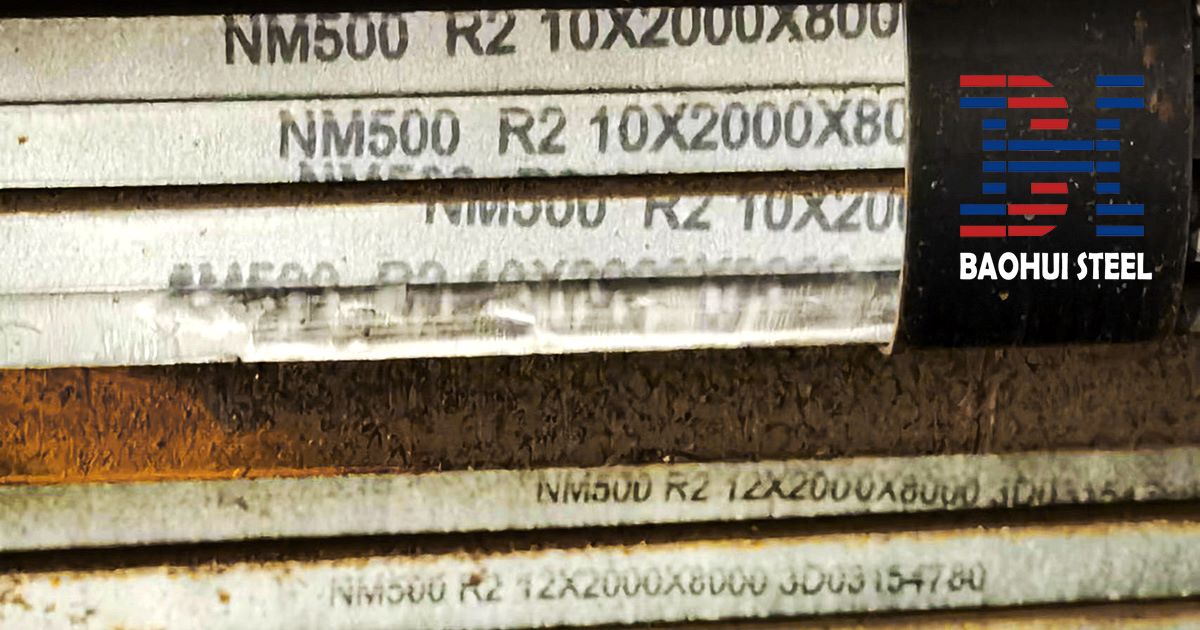
If you are sourcing 400 HBW wear plate, you will end up comparing Baosteel NM400 with SSAB Hardox 400 — the two most widely specified brands in this class. Marketing brochures on both sides claim equivalence. This comparison is different: it is built on guaranteed specification values (Baosteel's official product handbook and SSAB's datasheet) and on real mill test certificates from actual Baosteel heats we have supplied, so you can see measured numbers rather than promises.
Guaranteed values: NM400 vs Hardox 400
| Property | Baosteel NM400 (GB/T 24186) | Hardox 400 (SSAB datasheet) |
|---|---|---|
| Surface hardness | 400 ± 30 HBW | 370–430 HBW |
| Yield strength, min. | 960 MPa | 1,000–1,100 MPa (typical) |
| Tensile strength, min. | 1,200 MPa | 1,250 MPa (typical) |
| Elongation | ≥ 10 % | ≥ 10 % |
| Impact toughness | -40 °C KV2 ≥ 20 J (NM400E: ≥ 60 J) | -40 °C: 45 J (typical, longitudinal) |
| Thickness range | 1.5–25 mm (incl. the world's only 1.5 mm heat-treated wear plate) | 4–130 mm |
| Standard | GB/T 24186, Q/BQB delivery conditions | SSAB internal + EN practice |
Read the table the way an engineer should: Hardox 400 carries somewhat higher listed yield and typical impact figures, but both plates sit in the same 400 HBW hardness class with comparable tensile strength. In abrasion-dominated service — chutes, hoppers, liner plates, bucket bottoms — field life is governed first by hardness and microstructure, and there NM400 and Hardox 400 are direct equivalents.
What real Baosteel mill certificates actually show
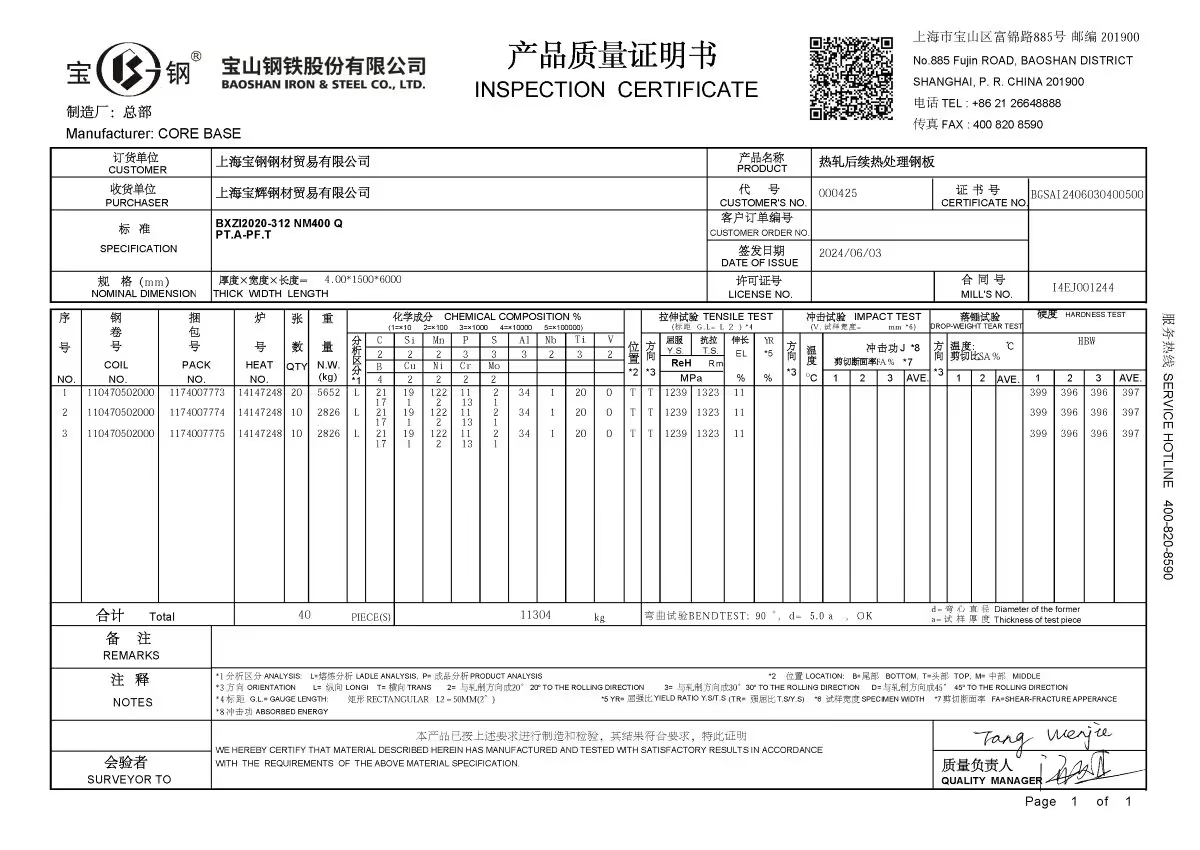
Specifications are floors, not typicals. Below are measured values transcribed from genuine Baosteel / Baowu mill test certificates (产品质量证明书) for NM400 plates — including one heat consigned directly to Shanghai Baohui Steel. These are not brochure numbers; they are the values stamped per heat on the certificates we hand to our customers.
| Certificate | Mill / base | Spec (mm) | Yield (MPa) | Tensile (MPa) | EL (%) | Impact KV2 | Hardness HBW (avg) |
|---|---|---|---|---|---|---|---|
| BGSAI2410200614900, issued 2024-10-20 | Baoshan (Shanghai) | 12 × 1800 × 12000 | 1,049 | 1,271 | 18 | 73 J at -20 °C (avg) | 413 |
| BGBWI2506110451600, issued 2025-06-11 | Wuhan Iron & Steel | 16 × 2000 × 12000 | 1,071 | 1,321 | 12 | 61 J at -20 °C (avg) | 419 |
| BGBWI2405200314900, issued 2024-05-20 | Wuhan Iron & Steel | 8 × 2000 × 12000 | 1,222 | 1,298 | 10 | 58 J at -20 °C (avg) | 419 |
| BGSAI2510281743500, issued 2025-10-28 | Baoshan (Shanghai), quenched + tempered | 5 × 1500 × 6000 | 1,256 | 1,269 | 11 | — | 427 |
Three things stand out. First, tensile strength runs 1,269–1,321 MPa against a 1,200 MPa minimum — real margin, heat after heat. Second, hardness lands in a tight 413–427 HBW band, inside the 370–430 HBW window Hardox 400 itself guarantees. Third, these are thin gauges (5–16 mm) from Baosteel's dedicated thin-plate heat treatment lines — exactly the range where SSAB alternatives are thinnest on supply.
Where Hardox 400 still leads
Fair comparison means saying where the incumbent is strong. Hardox 40 years of brand track record in European quarries and mines; a thicker plate envelope (up to 130 mm versus Baosteel's standard 1.5–25 mm heat-treated range); and, for buyers governed by EN-origin specifications, a name that needs no equivalence paperwork. If your specification simply says "Hardox 400 or equivalent approved", you will need mill certificates to approve the equivalent — which is where suppliers who can produce original certificates per heat win.
Where NM400 wins
Price per ton is the obvious one: NM400 from Baosteel sells at a materially lower price than Hardox 400 for the same hardness class, because you are paying for steel, not for a brand premium. Thin gauges are the second: 1.5–6 mm heat-treated wear plate is a Baosteel specialty that SSAB cannot match at volume — including the world's only 1.5 mm heat-treated wear plate. The third is increasingly decisive for EU and EMEA buyers: carbon documentation. Baosteel publishes EPDs (environmental product declarations) for its hot-rolled products on the CISA-EPD platform — verified per ISO 14025 by TÜV SÜD — and is building a hydrogen-based shaft furnace route in Zhanjiang aimed at 50–80 % lower emissions per ton. If your tender asks for embodied-carbon data, a Baosteel chain of custody answers it; most trading companies reselling Hardox cannot.
Which one should you buy?
- Choose NM400 for abrasion service in 1.5–25 mm gauges, cost-sensitive projects, and tenders that accept "400 HBW equivalent with mill certificates" — especially if you also need EPD or carbon data for EU compliance.
- Choose NM400E when impact loading matters (crusher liners, dump truck floors under rock drop): -40 °C KV2 ≥ 60 J versus 20 J for standard NM400.
- Stay with Hardox 400 only if your specification hard-codes the brand name, you need plates above 20 mm without an equivalence process, or your end customer simply will not approve a substitution.
For most wear applications we see — dump bodies, hoppers, chutes, mixer drums, grab buckets — NM400 delivers Hardox-class service life at a visibly lower landed cost, with the paperwork to prove what is in the plate. See the full NM400/NM450/NM500 series page for stock sizes and FOB pricing, our Baosteel supply page for the source chain behind these certificates, or the deeper three-way read AR500 vs Hardox 500 vs NM500 if you are weighing the 500 HBW class instead.
Need NM400 with original Baosteel mill certificates? Send us your thickness and quantity — we reply with stock availability and a firm FOB quote.