Baosteel NM500 vs Hardox 500: Specs, Price and Real Mill Certificate Data

Jay Zheng
Nov 12, 2026
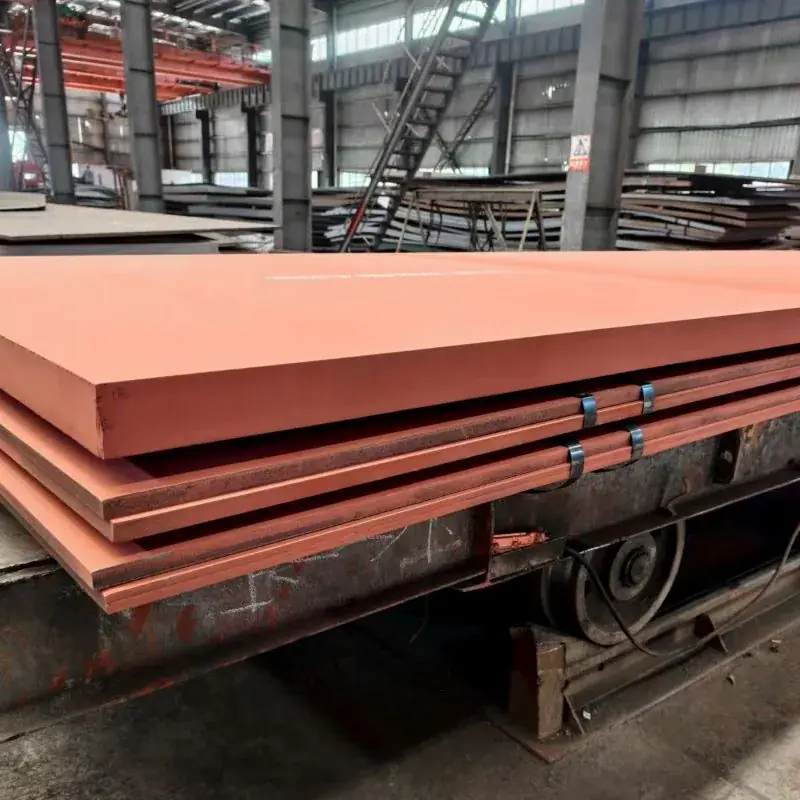
NM500 sits at the practical top of the wear-plate hardness scale — the grade you choose when abrasion, not impact, is what destroys your equipment. Its Swedish counterpart, Hardox 500, defined the class globally. The metallurgy on both sides is through-hardened quenched-and-tempered plate in the 500 HBW class; the differences are price, thin-gauge capability and documentation. As with our other comparisons, this page puts real results from a genuine Baosteel mill certificate — No. BGBWI2504240235400, a 12 mm plate rolled at Wuhan Iron & Steel (Baowu Group) and delivered in April 2025 — next to the published guarantees.
NM500 vs Hardox 500: guaranteed specifications
| Item | Baosteel NM500 | SSAB Hardox 500 |
|---|---|---|
| Standard / basis | GB/T 24186 + Baosteel technical delivery conditions | SSAB product datasheet |
| Hardness guarantee | 500 HBW class — delivered plates typically measure 470–540 HBW | 470–530 HBW (plate ≤ 32 mm); 450–540 HBW (32.1–103 mm) |
| Yield strength | Real certificate: 1,410 MPa (ReL) | Typical 1,400 MPa — not guaranteed |
| Tensile strength | Real certificate: 1,723 MPa | Not stated as a guarantee on the datasheet |
| Impact toughness | Contract option; real certificate: KV2 avg 62 J at −20 °C | Standard grade: typical values only; Hardox 500 Tuf guarantees 27 J at −20 °C (transverse) |
| Thickness range | ≈ 1.5–25 mm heat-treated plate (incl. the 1.5 mm class unique to Baosteel); heavier gauges on request | Plate 4.0–103 mm; sheet 2.0–7.0 mm |
| Delivery condition | Quenched + tempered | Quenched + tempered (through-hardened) |
What a real NM500 certificate shows
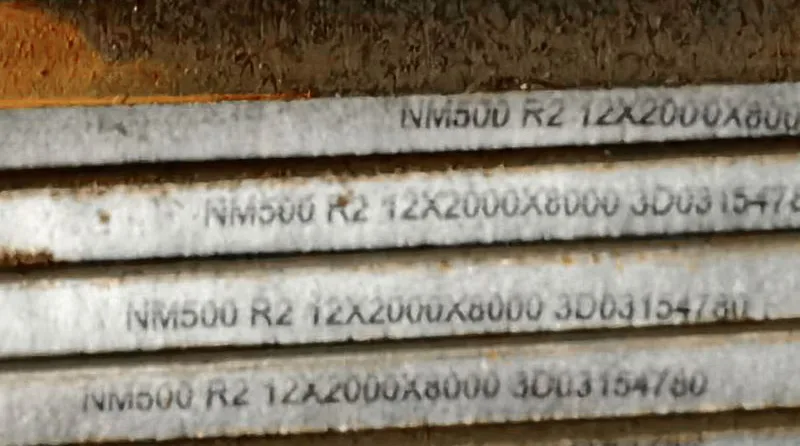
The values below are transcribed from inspection certificate No. BGBWI2504240235400, issued by Wuhan Iron & Steel Co., Ltd. — the Wuhan base of Baowu Group — on 24 April 2025 for a delivered 12.00 × 2000 × 12000 mm plate:
| Property | Certificate result | Reading |
|---|---|---|
| Brinell hardness | 518 / 516 / 518 HBW, average 517 | Comfortably inside the Hardox 500 hardness window |
| Yield strength ReL | 1,410 MPa | Matches the Hardox 500 typical value — as a measured result |
| Tensile strength Rm | 1,723 MPa | Very high strength reserve for extreme wear parts |
| Elongation A | 11 % | Normal for the class — hardness is bought with ductility |
| Charpy V KV2, −20 °C | 54 / 69 / 64 J, average 62 J | Above the Hardox 500 Tuf guaranteed level, on the base grade |
| Bend test | 90°, d = 8a (96 mm mandrel on 12 mm), OK | Forms cold with generous radii |
| Ladle analysis | C 0.27 %, S 0.001 %, CEV ≈ 0.61, Cr 0.67 % | Hardness chemistry — weld with discipline |
Two readings matter commercially. First, the toughness line: 62 J average at −20 °C on the base grade is a strong number — SSAB itself only guarantees 27 J at −20 °C on the separate Hardox 500 Tuf product. For buyers in cold climates or high-impact duty, that is headroom you do not pay extra for. Second, the chemistry line: C 0.27 % and CEV ≈ 0.61 is honest hardness chemistry. The plate welds well, but it demands low-hydrogen consumables, controlled heat input and preheat on thicker sections — treat it like the high-hardness grade it is, and it performs. Our line-by-line MTC guide shows how to verify these fields on any certificate you receive.
Where Hardox 500 still has the edge — and where NM500 wins
Hardox 500 keeps its role where the specification is written around the brand: OEM documentation, European and American stock programs, and projects where the name itself is the procurement requirement. NM500 wins the economic comparison decisively: a materially lower FOB price per ton for the same hardness class (indicatively 820–900 USD/MT for standard sizes, versus the SSAB premium), thin heat-treated gauges down to 1.5 mm — a Baosteel unique — and mill documentation including ISO 14025-verified EPDs. When the wear part is consumption steel, not a branding exercise, the certificate data above is the technical basis for an equivalent-submission bid.
Choosing between NM450, NM500 and the E-grades
Stay with NM450 for general severe wear with forming and welding in the workshop. Move to NM500 when pure sliding abrasion dominates: crusher liners, bucket lips and heels, screw conveyors, glass-recycling equipment, sand and gravel plant wear parts. Choose NM500E when the same duty arrives with impact or sub-zero temperatures and a brittle fracture would stop the machine. And remember the whole NM series is available from 1.5 mm — at the thin end, the world's only 1.5 mm heat-treated wear plate is a Baosteel product. See the full NM400/NM450/NM500 series page for stock sizes and FOB pricing, the NM450 vs Hardox 450 comparison for the middle class, or the AR500 vs Hardox 500 vs NM500 three-way read if you are also weighing the American AR standard.
Need NM500 with original Baosteel mill certificates? Send us your thickness and quantity — we reply with stock availability and a firm FOB quote.
Further reading: