Electrical Steel Grade Equivalents: How to Read GO & NGO Designations Across China, EN, JIS and AISI Standards

Jay Zheng
Nov 8, 2026
Quick answer: Electrical steel grades from different countries are class correspondences, not exact equivalents. A Chinese 35WW300, a European M300-35A, a Japanese 35A300 and an American AISI M19 all sit in the same loss class (≈3.00 W/kg at 1.5 T / 50 Hz for non-oriented steel), but guaranteed values, test conditions and coatings differ between standards. Always confirm the exact grade and guaranteed magnetic values on the mill test certificate (MTC) before ordering. This guide explains the four designation systems and gives complete cross-reference tables for both non-oriented (NGO) and grain-oriented (GO) steel.
Non-oriented (NGO) vs grain-oriented (GO): two product families
Non-oriented electrical steel (NGO / CRNGO) has magnetic properties that are nearly the same in all directions of the sheet. It is punched into laminations and used in rotating machines — motors, generators, compressors, pumps — and small transformers. Its core loss is measured at 1.5 T / 50 Hz (written P1.5/50) and its magnetization at 5,000 A/m (J5000). Grain-oriented electrical steel (GO / CRGO) has a strong crystal texture that gives very low loss along the rolling direction. It is slit into strips for stacked transformer cores. GO grades are measured at 1.7 T / 50 Hz (P1.7/50) and their magnetization at 800 A/m (J800), because transformer cores operate at higher induction. The two families are not interchangeable: never substitute an NGO grade for a GO design or vice versa.
How to read the grade designations
Chinese system (Q/BQB 480-2023 for NGO, Q/BQB 485-2023 for GO; GB/T 2521.1-2016 national)
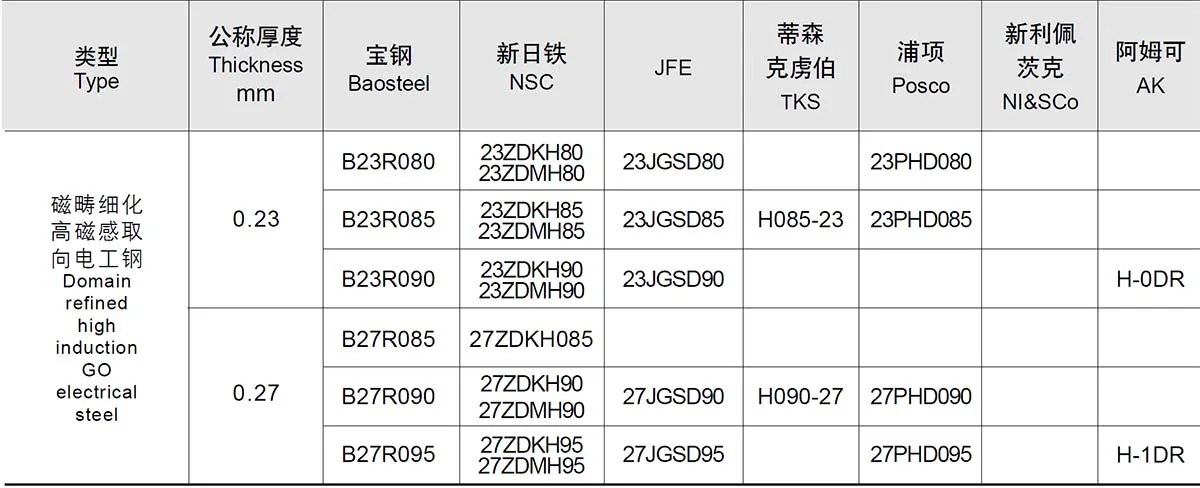
NGO: In 50WW470 — 50 = 0.50 mm nominal thickness, WW = conventional non-oriented (WH = high-efficiency), 470 = nominal loss in W/kg ×100 at 1.5 T / 50 Hz (i.e. 4.70 W/kg). The B-prefix form B50A470 is Baosteel's enterprise grade (B = Baosteel, A = conventional NGO). In GB/T 2521.1 the same material is written 50W470. GO: In 27Q120 — 27 = 0.27 mm, Q = 取向 grain-oriented, 120 = nominal loss at 1.7 T / 50 Hz (1.20 W/kg). Suffixes refine the family: RD (R = laser domain refinement, D = distribution-transformer design, e.g. B23RD070), P/QG (high permeability / HiB, e.g. B23P085 / 23QG085, J800 up to 1.90 T).
European system (EN 10106 for NGO, IEC 60404-8-7 style for GO)
EN 10106: M300-35A — M300 = loss class 3.00 W/kg at 1.5 T / 50 Hz, 35 = 0.35 mm, A = insulation coating class (A = semi-organic thin coating). GO (IEC style): 120-27 or 120-27H — loss first, thickness second; the trailing H marks high-permeability (HiB) material.
Japanese system (JIS C 2552)
50A470 — 50 = 0.50 mm, A = non-oriented, 470 = loss class. GO products from Japanese mills are usually quoted as proprietary classes (e.g. 23ZDKH, 27ZH) rather than a unified JIS numbering, which is why the GO table below lists JIS entries as "class" references only.
American system (AISI / ASTM)
M19, M27, M36… — AISI loss classes defined in W/lb at 1.5 T / 60 Hz. Because of the 60 Hz basis, AISI class numbers cannot be converted arithmetically into W/kg at 50 Hz; the correspondence is by loss class band, and it is the least precise of the four systems. For GO, US buyers typically specify directly by IEC-style grades.
Complete cross-standard tables (non-oriented, 50 Hz classes)
| China Q/BQB 480-2023 (Baosteel) | China GB/T 2521.1 | EN 10106 | JIS C 2552 (class) | AISI (class) | Max P1.5/50, W/kg (Q/BQB) |
|---|---|---|---|---|---|
| B35A250 / 35WW250 | 35W250 | M250-35A | 35A250 | M15 | 2.45 |
| B35A300 / 35WW300 | 35W300 | M300-35A | 35A300 | M19 | 2.65–2.90 |
| B35A440 / 35WW440 | 35W440 | M350-35A | 35A440 | M27 | 3.40 |
| B50A310 / 50WW310 | 50W310 | M330-50A | 50A310 | M19 | 2.75 |
| B50A400 / 50WW400 | 50W400 | M400-50A | 50A400 | M22 | 3.30 |
| B50A470 / 50WW470 | 50W470 | M470-50A | 50A470 | M27 | 3.30–4.20 |
| B50A600 / 50WW600 | 50W600 | M600-50A | 50A600 | M36 | 4.20–4.70 |
| B50A700 / 50WW700 | 50W700 | M700-50A | 50A700 | M43 | 4.70 |
| B50A800 / 50WW800 | 50W800 | M800-50A | 50A800 | M36 / M43 | 5.50–5.80 |
| B50A1000 / 50WW1000 | 50W1000 | M1000-50A | 50A1000 | M47 | 6.00 |
Where a range is shown, the lower value is Baosteel's enterprise grade (WW series) and the higher value the GB/T 2521.1 national grade (B-series). Enterprise grades typically guarantee 10–20% lower loss than the corresponding national grade — one reason buyers specify 50WW470 over 50W470 on transformer and motor contracts.
Complete cross-standard tables (grain-oriented, 50 Hz classes)
Conventional GO
| China Q/BQB 485-2023 | IEC 60404-8-7 style (class) | JIS class (reference) | Max P1.7/50, W/kg | Min J800, T |
|---|---|---|---|---|
| B23G110 / 23Q110 | 110-23 | 23ZDKH / 23ZH class | 1.08 | 1.85 |
| B27G120 / 27Q120 | 120-27 | 27ZDKH / 27ZH class | 1.15 | 1.85 |
| B30G120 / 30Q120 | 120-30 | 30ZDKH / 30ZH class | 1.15 | 1.86 |
| B30G130 / 30Q130 | 130-30 | 30ZDKH class | 1.20 | 1.85 |
| B35G135 / 35Q135 | 135-35 | 35ZDKH class | 1.35 | 1.88 |
Domain-refined GO (distribution transformers)
| China Q/BQB 485-2023 | IEC style (class) | Max P1.7/50, W/kg | Min J800, T |
|---|---|---|---|
| B20RD065 / B20RD070 | 065-20 / 070-20 | 0.64 / 0.69 | 1.88 |
| B23RD070 | 070-23 | 0.70 | 1.88 |
| B23RD075 / B23RD080 | 075-23 / 080-23 | 0.74 / 0.78 | 1.88 |
| B23RD085 / B23RD090 | 085-23 / 090-23 | 0.81 / 0.87 | 1.88 |
High-permeability GO (HiB, power transformers)
| China Q/BQB 485-2023 | IEC style (class) | Max P1.7/50, W/kg | Min J800, T |
|---|---|---|---|
| B23P085 / 23QG085 | 085-23H | 0.85 | 1.90 |
| B23P090 / 23QG090 | 090-23H | 0.88 | 1.89 |
| B27P090 / 27QG090 | 090-27H | 0.89 | 1.90 |
| B27P095 / 27QG095 | 095-27H | 0.93 | 1.90 |
| B30P105 / 30QG105 | 105-30H | 1.01 | 1.90 |
All tables show class correspondence for reference only. Guaranteed values, test frame conditions and coating systems differ between standards. Confirm the exact grade on the mill test certificate before ordering.
Why AISI↔EN↔GB numbers never match exactly
Three reasons. First, frequency: AISI classes are defined at 60 Hz in W/lb, while EN and GB values are at 50 Hz in W/kg — a different measurement basis entirely. Second, guaranteed vs nominal: the GB/Q number is usually nominal (e.g. 470 = 4.70 W/kg nominal) while the standard guarantees a lower maximum (e.g. 3.30 W/kg max for 50WW470); EN numbers are loss-class labels, not guarantees. Third, test induction: NGO is tested at 1.5 T, GO at 1.7 T. A spec sheet that mixes P1.5/50 and P1.7/50 values is almost always an error — treat it as a red flag when comparing suppliers.
How to verify a grade on the mill test certificate (MTC)
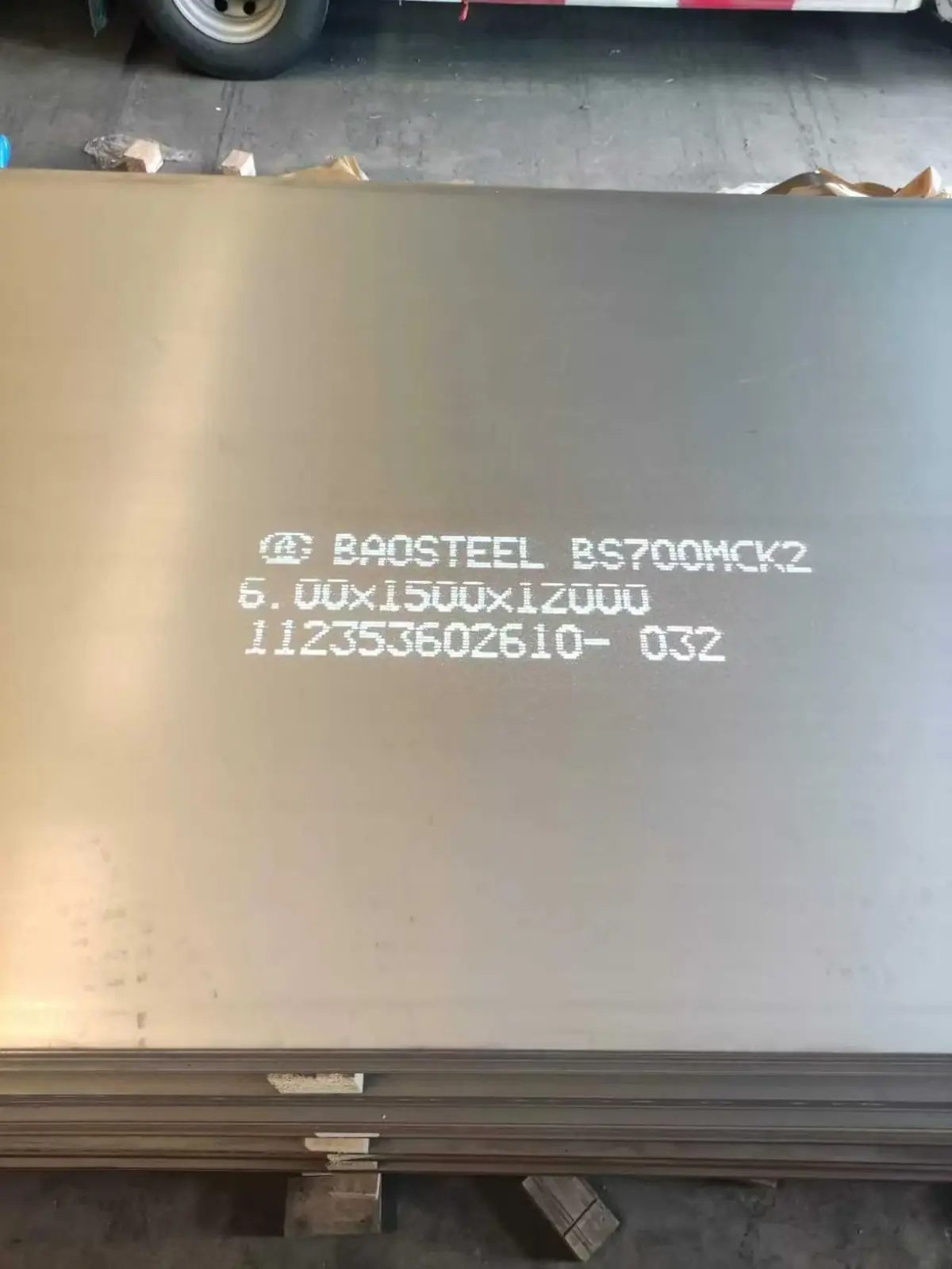
- Check the standard printed on the MTC — it should read Q/BQB 480-2023 (NGO) or Q/BQB 485-2023 (GO), or the GB/T 2521.1 national standard. A certificate without a standard reference cannot be audited.
- Read the magnetic values per heat number: for NGO, P1.5/50 (W/kg) and J5000 (T); for GO, P1.7/50 (W/kg) and J800 (T). Guaranteed values must be ≤ the standard's maximum (loss) and ≥ the minimum (polarization) for the ordered grade.
- Watch for typical vs guaranteed values. Marketing sheets quote typical (average) values, which are 5–10% better than guaranteed. Contracts must reference guaranteed values.
- Confirm coating class (A/C5/C6 for NGO; S/H for GO) matches your process — annealing temperature, punchability, interlaminar resistance.
Baohui's electrical steel supply
Baohui Steel is a long-standing Baosteel channel partner. We supply the full NGO range (M19 / 35WW300, M27 / 50WW470, M36-M43 / 50WW800) and the GO families — conventional 27Q120, domain-refined B23RD070/080 and high-permeability B23P085/B27P090 — as coils with the original Baosteel MTC. Send your grade, thickness, width and quantity for a firm FOB Shanghai quotation within 24 hours, or browse the electrical steel category page for the full stock list. You can also read our deeper dives: China's GO silicon steel export growth and energy-efficiency-driven demand in appliances and EVs.